Tag: chukar vest

  • Quilomene Upland Bird Vest Review

    Quilomene Upland Bird Vest Review

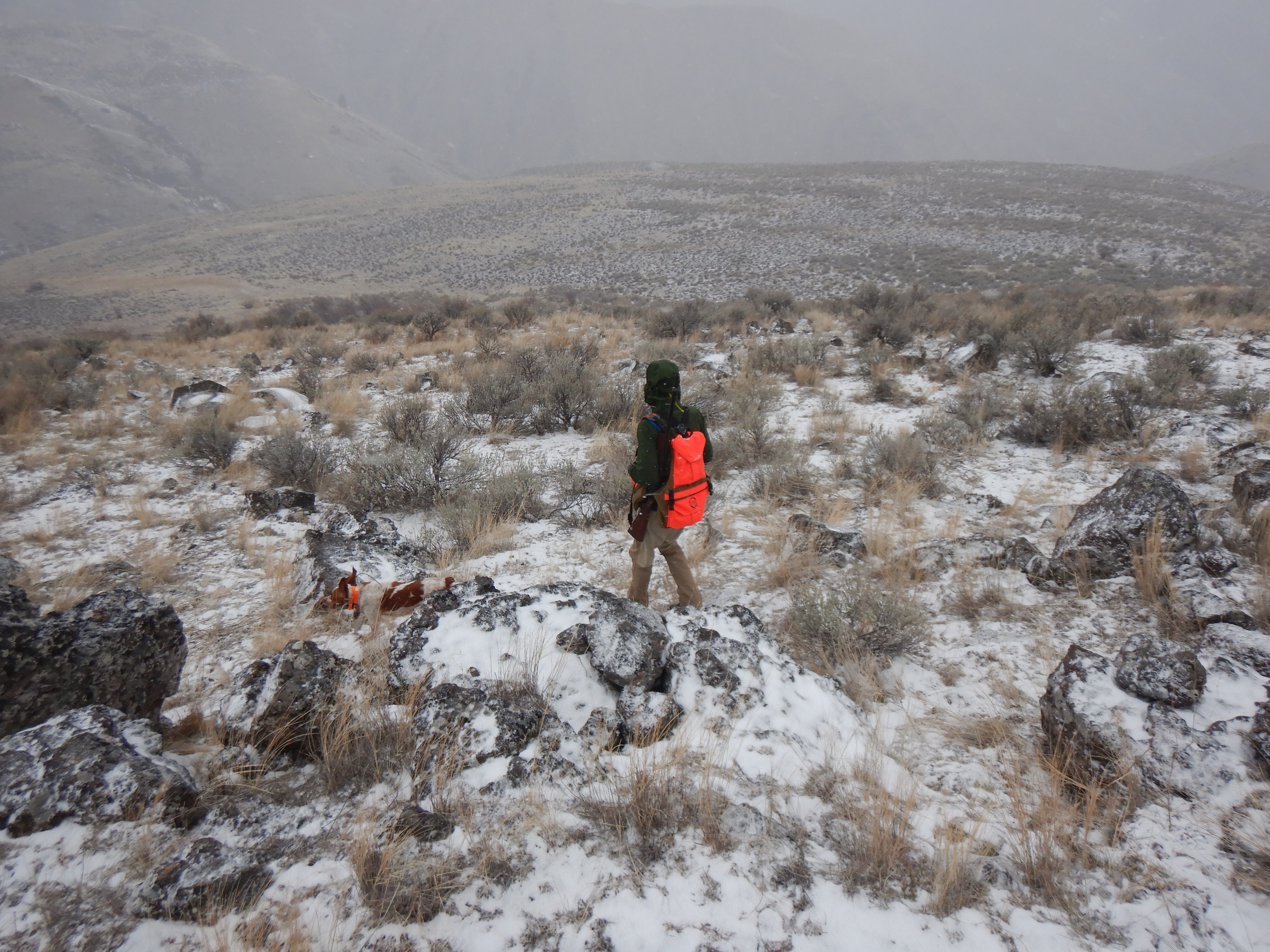
    Heading out with the Quilomene Upland Bird Vest, nothing in the bird bag yet

    Just before New Year’s my new Q5 chukar vest arrived, which I’d ordered on November 30th: the Quilomene Upland Bird Vest. I’d been using the Badlands Upland Vest (no longer available) for the past couple of seasons and — as the weather asked us to bring more apparel, which goes on and off depending on the terrain — I started finding it just didn’t have the carrying capacity I wanted, especially as the bird bag began being burdened by bigger bunches of birds. The Badlands vest is still my favorite overall vest, but it’s not perfect and I continued to wonder if a perfect vest existed.

    So I looked and looked: I looked at the Tenzing BV16 (currently out of stock everywhere I looked), at the Filson Pro Guide Strap Vest (no longer available), the Orvis Pro Series Hunting Vest (won’t work with a hydration bladder), Oregon Pack Works Rogue Bird Pack (not much information and only one photo, and by far the most expensive), and Wingworks Upland Wingshooting Vests (unavailable; I’ve been trying to get one of these for quite a while now). L.L. Bean makes a cool-looking vest, but I tried it a few years ago and returned it after one hunt because the water bladder sat too low in the pack to get it to flow without standing on my head. I’d used the Q5 Centerfire for a couple of seasons and really liked it, but ultimately found it too bulky for my style of chukar hunting, but decided to take another look at their wide variety of upland vests.

    On the Q5 site, the Quilomene Upland Bird Vest looked like it might be the ticket: bladder-ready, easily-accessible large bird bag, moderate storage, modular straps (can add/remove accessory and shell pockets), and lash-strap ready for external carrying options. I’m about 6′ and 155, so I ordered the smallest waist belt, and it just fits cinched as tight as it goes; skinnier folks will probably find it too loose.

    When I ordered it, the site showed one message saying they were running a 2-week lead time on new orders, and — somewhere else on the site — a 30-day turnaround. I received mine a month after they charged my card. The current message (as of 1/10/20) shows 30 days out and “unable to provide any status updates.” It’s ironic that chukar hunting seems never to have been more popular, yet it’s nearly impossible to get a new vest quickly, and the choices seem to be shrinking. Not sure what to make of that, other than American manufacturing doesn’t seem to be faring too well at the moment; the only two vests I mentioned that are available (the Orvis and the L.L. Bean) are not made in the U.S.

    Anyway, I was very excited when the Quilomene vest finally arrived. It took a while to set it up to fit, but once I’d made some velcro adjustments, shortened the shoulder straps as far as they’d go (see more on this below), and added the two shell pockets to the padded hip belt, I was ready to install my 100-ounce Camelback hydration bladder. This wasn’t easy. The bladder pouch is directly against your back (which is moderately uncomfortable when the bladder’s full), and there is a hole on both sides of the bottom of the pouch, intended for the hydration bladder’s hose to exit the pouch for routing somewhere on the vest. The problem with this is that most bladders have their hoses exiting the bladder at an upward right angle; I hadn’t realized this until I couldn’t get any water out of the hose and had to pull the whole bladder out to see what the problem was. No matter how I tried routing the hose through the bottom holes in the pouch, the hose got kinked and wouldn’t flow. So I ended up running the hose up the inside of the pouch and out the top; not a huge deal, and it works fine.

    Bladder pouch with hose coming out the top
    Top of the Camelbak bladder; note the retainer clip: the vest’s pouch doesn’t feature anything to clip it to

    Another issue with the vest if you use a bladder is that there’s nothing at the top of the bladder pouch to attach to the top of the bladder to keep it from sloughing down in the pouch as the water level drops. Most bladders have something at the top near the fill point to counteract gravity so the flow doesn’t get interrupted; the Q5 Centerfire did, but this vest doesn’t.

    Hose clip sewn into right shoulder strap
    After cutting out the clip; I used a flame to seal the loose nylon threads…

    Still another problem with my particular set up is that I ordered a water hose retainer clip, which the Q5 video shows as removable, so I assumed it would come loose and I could put it wherever I wanted. But it was sewn low down on the right shoulder strap. The first problem here is that a right-handed shooter probably won’t want the drinking tube on the right side; second problem is that it’s sewn into the strap and prevents me from shortening the shoulder strap below the clip. I wanted to shorten the straps to get the vest to ride higher, so I had to cut the clip out (more on that below).

    The other negatives I’m experiencing with this vest (I’ve hunted with it a half-dozen times now) have to do with the shell pockets. I ordered a standard Q5 shell pocket for my shells, which I keep on the right side and a Quilomene pocket for the left, which looked like it’d be roomy enough for me to carry our small camcorder. It’s not, but it’s bulkier and takes up more hip-belt real estate so that it rides on my left thigh when I’m climbing (very annoying), and requires two hands to open. The Q5 shell pocket holds a lot more shells than I’m used to, which I appreciate, but is not nearly as user-friendly as the substantially smaller Badlands magnetic closure shell pockets; for quick reloading, especially with gloves, the Q5 shell pockets are not easy to manipulate with one hand.

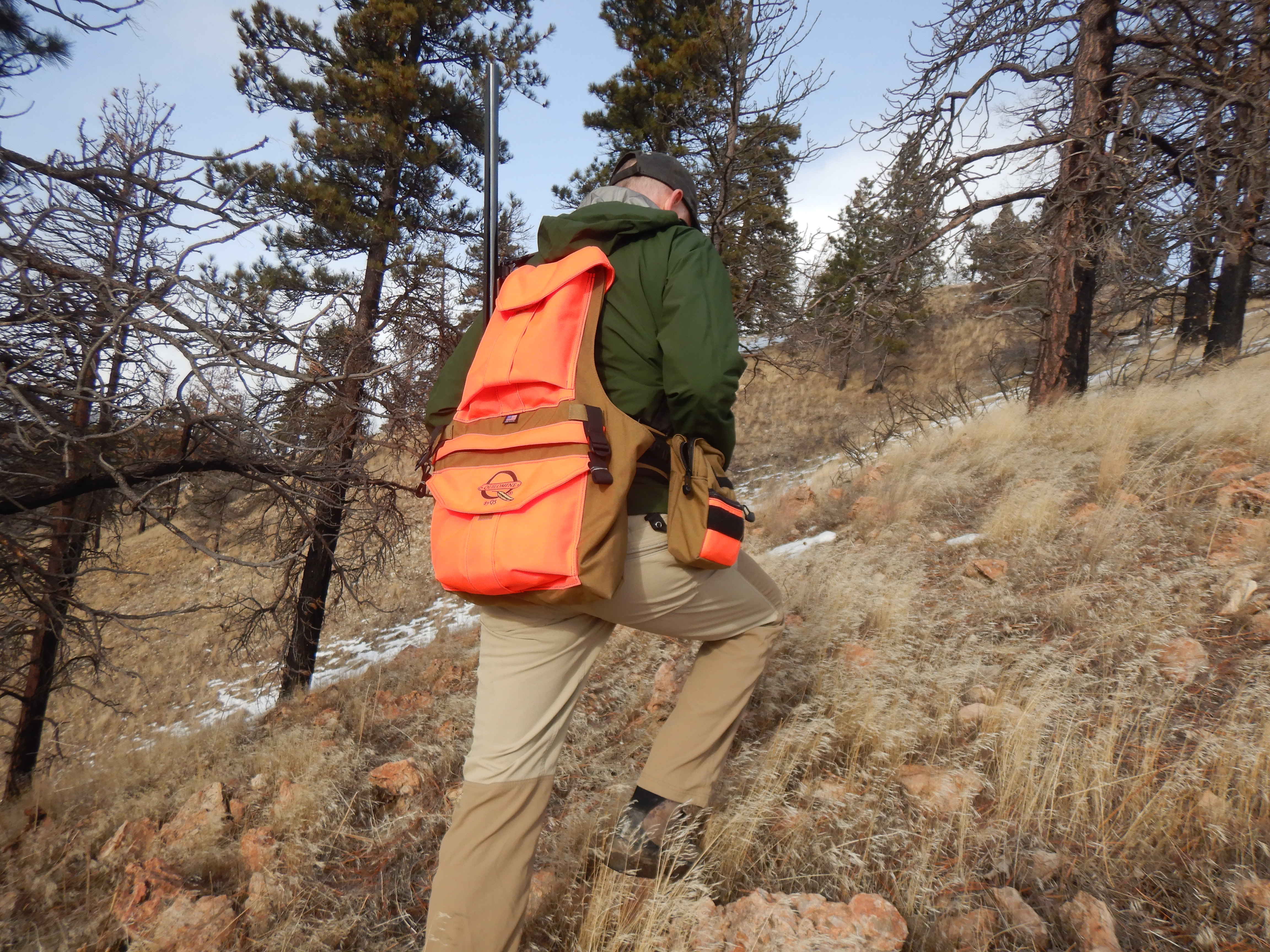
    With just a couple birds in the bag, it falls lower on my body than I’d like

    The bird bag is really big and easy to get birds into, as long as the storage pockets (which sit on the outside of the top layer of the bird bag) aren’t too heavily loaded with gear, or you don’t have a heavy garment or elk shed lashed to the outside of the bag; if this is the case, you have to push hard backward to gain enough space to drop the bird in the pouch. Without birds in the bag, it rides much lower than I’d like, and when I’ve got a bunch of birds in it, it bangs on the bottom of my butt with every step, which gets old fast. At 6′, I don’t think the vest should hang as low as it does.

    Bird bag, secured by snaps and velcro, opens to adjust the strap length and clean out the pouch

    So after cutting the sewn-in clip out of the right shoulder strap I shortened the straps a lot to see if I could get it to ride higher so the bird bag doesn’t ride on my rump. I was able to shorten the straps to get the bag to ride below the small of my back and on the top of my butt, but this moved the padded hip belt above my waist: not an option! So it seems the vest is definitely designed to ride as low as it does, which doesn’t make a lot of sense to me, but what do I know?

    I don’t hate this vest. I really wanted to like it. At $240, it should be high quality, which I think it is, at least as far as the materials. The heavy-duty nylon and plastic components seem durable, although I do wonder if the very bright blaze sections will quickly fade as they did on my Centerfire vest. It’s been a long time since I’ve used a strap vest, so I wasn’t sure how I’d like the basic no-frill, unpadded nylon shoulder straps, and they’re actually a lot more comfortable than I expected. Ultimately, I just don’t like the fact that it’s designed to ride so low. If anyone’s interested, it’s available for $200, and I’ll throw in a couple of our new iron-on patches.

    Our new Chukar Culture embroidered patch

    The bottom line is that this — so far — is definitely not my perfect chukar vest. I still haven’t found it and suspect it probably doesn’t exist.

    Pros:

    • Fairly comfortable (aside from the butt-whomping)
    • Adjustable (within limits)
    • Good amount of storage capability
    • Easy to get birds in the bag (as long as you’re not carrying a lot of stuff in the storage pouches)
    • High quality components and construction

    Cons:

    • Q5 shell pockets not easy to use with one hand
    • Quilomene shell pockets almost impossible to use with one hand
    • Water bladder setup not well designed
    • Removable components should not be sewn onto vest
    • Expensive
    • Long lead times
  • Eberlestock Mini-Me Minimalist Bird Hunting Hydration Pack

    Eberlestock Mini-Me Minimalist Bird Hunting Hydration Pack

    Leslie and her gun (and Eberlestock Mini-Me pack)

    If you count calories, weigh your gear, track your vertical, get weepy at the word “minimalism,” or fancy a lightweight pack/vest for chasing chukar, the Eberlestock Mini-Me might be worth a look. Leslie has donned it exclusively for her debut season as a hunter, and – as far as I can tell from her notes – gives it a thumbs-up.  After twenty outings, here are her thoughts.

    Pros

    • Lightweight: at 3.5 pounds (dry), it’s easily the lightest thing we’ve used on a chukar hunt.
    • Compact: at 19″ x 8″ x 3″, it’s also the most compact pack I can imagine for chukar hunting, which makes busting through brush easier than with my Q5 “Cadillac” Centerfire vest.
    • Very comfortable: the channeled padding on the back will prevent anything from poking your back, and allows a bit of airflow back there, especially nice on a hot day.
    • Hydration system: the Mini-Me includes a three-liter (100 oz.) Israeli-made hydration bladder that works as well or better than any of the CamelBak products we’ve used.
    • Rides high: the “hip belt” on the Mini-Me actually goes across your waist (unless you’re a midget), which means that the accessory pouches you’ll need to add in order to hold shells won’t bang on your thighs when climbing the chukar steeps.
    • Accessory pouches (we have the “small” ones, each of which has plenty of room for a box of shells) slide along the hip belt to you can position them on the side or in the front.
    • Bird bag: made of durable mesh with a drawstring top and compression straps, the attached bird bag stows away inside a zippered pouch when not needed. When it’s out, it will hold lots of birds; on one hunt we put 2 large dusky grouse in it, which seemed to take up less than half the capacity of the bag.
    • Scabbard accessory: if you don’t want to, or can’t, carry your shotgun (or rifle) while hiking (or mountain biking), Eberlestock offers both a long and short scabbard accessory that attaches to a sleeve on the Mini-Me. Although we haven’t used the scabbard in the field yet (we have slings and typically hunt right from the rig), the short scabbard nicely and snugly holds our shotguns with 26″ barrels.
    • Multi-use: one of the reasons I wanted to try the Mini-Me was because in the off-season we do lots of hiking with our dogs and I wanted a pack that I could use for both hunting and hiking, without having to transfer a bunch of safety gear from my hunting pack to a hiking pack. The removable accessory pouches make this possible, and if the scabbard isn’t installed, you can use the sleeve it fits in for storing bulkier items like extra layers or rain gear. We also mountain bike frequently in the off-season, and the Mini-Me works great for that, especially with the hydration bladder. If you do MTB hunts, the scabbard accessory would solve the problem of how to safely carry your gun while riding.
    • Blaze “orange”: it’s more fluorescent pink, but you can see this thing from outer space. It glows bright. I like that, because I can see Leslie easily from many ridges away. If you don’t like this color and don’t need to have a certain number of square inches of hunter orange, the Mini-Me comes in a number of attractive camo patterns.

    Cons

    • Fit: the Mini-Me does take a bit of adjusting to get it to fit comfortably, as well as to accept the high ride of the “hip” belt.  Personally, I would prefer a more robust padded hip belt, but Leslie doesn’t seem to mind the thin nylon straps.
    • Hydration cap: although a small annoyance, the cap on the hydration bite valve is tough to remove and replace with one hand; CamelBak bite valves don’t have a cover on them and we’ve never had an issue with those, so we’ll probably just remove the cap on this one.
    • Accessory pouches can’t easily be fixed on the hip belt so they don’t slide around while hiking; one could modify the belt to fix this but we haven’t tried that yet.
    • Zippers on pouches are tough to open and close with one hand (true of most bird vests we’ve tried).
    • Bird bag clips that attach the top of the bag to the shoulder straps on the Mini-Me are nearly impossible to remove when you want to re-stow the bag. These need to be replaced with something much more user-friendly.
    • Using the game bag: to put birds in the bag, you must take the pack off. Unlike a traditional bird vest, which allows you to slip the bird into the compartment in the back, the Mini-Me access to the top of the bag requires removal of the pack. This hasn’t been  as annoying as it sounds, though, because we haven’t constantly nailed birds this season (yet?), and if we’ve been with another person they can easily put the bird in the bag so the wearer doesn’t have to remove it. Another issue, although not a big one, is that when the bird bag is deployed, it’s a bit tricky accessing the other pockets on the bag; having clips that are easier to remove from the D-rings on the shoulder straps would make this almost no issue at all.
    • Limited storage: just as you wouldn’t carry all your camping gear and outdoor recreation equipment in a sports car, the Mini-Me isn’t intended to schlep every piece of bird hunting kit you might want. But it can hold the essentials in its several zippered pockets, as well as additional clothing, gloves, etc. The accessory pouches you can add to the belt also expand carrying capacity.

    Overall Impression

    Leslie really likes the Mini-Me for early season chukar hunting, mainly because of its comfort and lightness. She plans to switch to her larger pack for the colder part of the season to accommodate the extra layers and gloves she doesn’t think will easily fit into the Mini-Me. My impression is that it’s a pretty cool option for a lightweight chukar pack, especially because of how much water it holds without being at all bulky. It has worked especially well for us, hunting together, because my vest carries a ridiculous amount of crap in it, stuff we only need one of, like heavy-duty cable cutters (for snare traps), a robust first-aid kit, headlamps, SPOT personal locator beacon thingy, space blankets, and more. Despite its littleness, though, Leslie has found very workable places to carry an FRS radio and her new Alpha 100 hand-held device on the Mini-Me. So there you have it. Let us know if you have any questions.

    Slim, compact, bright!

    Two dusky grouse in the bag

    Have a friend load the bag, or take off the pack and do it yourself

    Accessory pouches on the skinny hip belt

    The small pouches actually hold plenty of shells


  • What’s In Your Vest?

    My bag
    My bag

    After watching the Fish & Game videos and learning that a snare trap can kill my dogs if I can’t get the cable off, I decided I now need to carry a pair of short-nose cable cutters along with all the other crap in my vest. Aside from the fact that they’re ridiculously expensive ($65 on Amazon; Harbor Freight didn’t have anything similar, and I found a pair of knock-offs that were made of aluminum), my pack is starting to get heavier than I’d like. So I thought I’d weigh out everything and see what others have in theirs in case I’m carrying too much, or – gulp! – not enough.

    Here’s what I’m working with:

    • Badlands Vest: 2 lbs., 14 oz.
    • 100 oz. hydration bladder & hose, with  sleeve: 5 lbs., 10 oz.
    • Garmin Alpha GPS handheld with belt clip: 9.2 oz.
    • Garmin Delta transmitter (for Peat’s collar): 3.9 oz.
    • 1 box 12g shells (2-3/4″ Rio 7-1/2 shot,1-1/8 oz lead): 2 lbs., 5 oz.
    • Leatherman “Wingman”: 6.8 oz.
    • First aid kit: 14.3 oz.
    • Baby aspirin (for Angus): .5 oz.
    • Vaseline in a container (cheatgrass deterrent for dog ears): 1.1 oz.
    • Panasonic Lumix camera: 7 oz.
    • Smart phone: 6 oz.
    • Wallet: 3.9 oz.
    • Spot Gen3 emergency beacon: 4.1 oz.
    • 6′ dog leash: 6 oz.
    • Snacks for me & dogs: 10 oz.
    • Felco C7 cable cutter: 12 oz.

    Total weight: a little over 16 pounds. The above doesn’t include extra clothes or gloves or hat. When I pulled everything out of my vest I was surprised to find that I had a total of 31 shells in it, extras – including 6 steel #6 shells – stashed in various places. Better to have too many than not enough, but out of the above items I think I might pare down the number of shells I bring with me. I think the most I’ve ever shot was 19 times in one hunt (and that was an epic day: 0 for 19).

    Items I should think about adding? Headlamp? Fire starter? Lighter? More food? Most of my hunts last between 2.5 and 5 hours. I like my vest but have often wished it had larger pockets so I could carry more clothing and maybe a little more food, but this setup has worked well for me the past several years. I’d love to hear from anyone about something I’m a total idiot for not bringing along… As I’ve already established, I am an idiot when it comes to these birds.