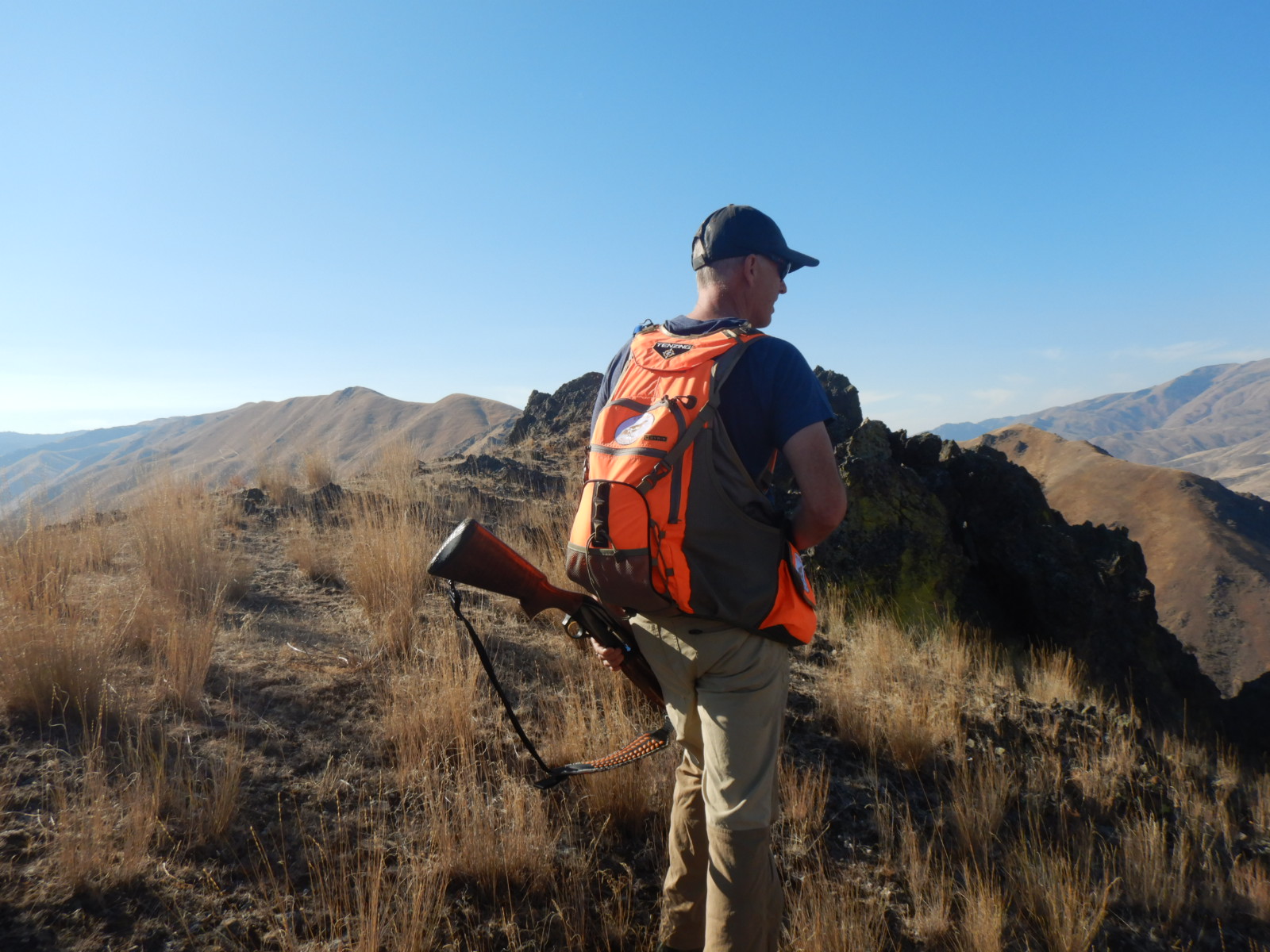
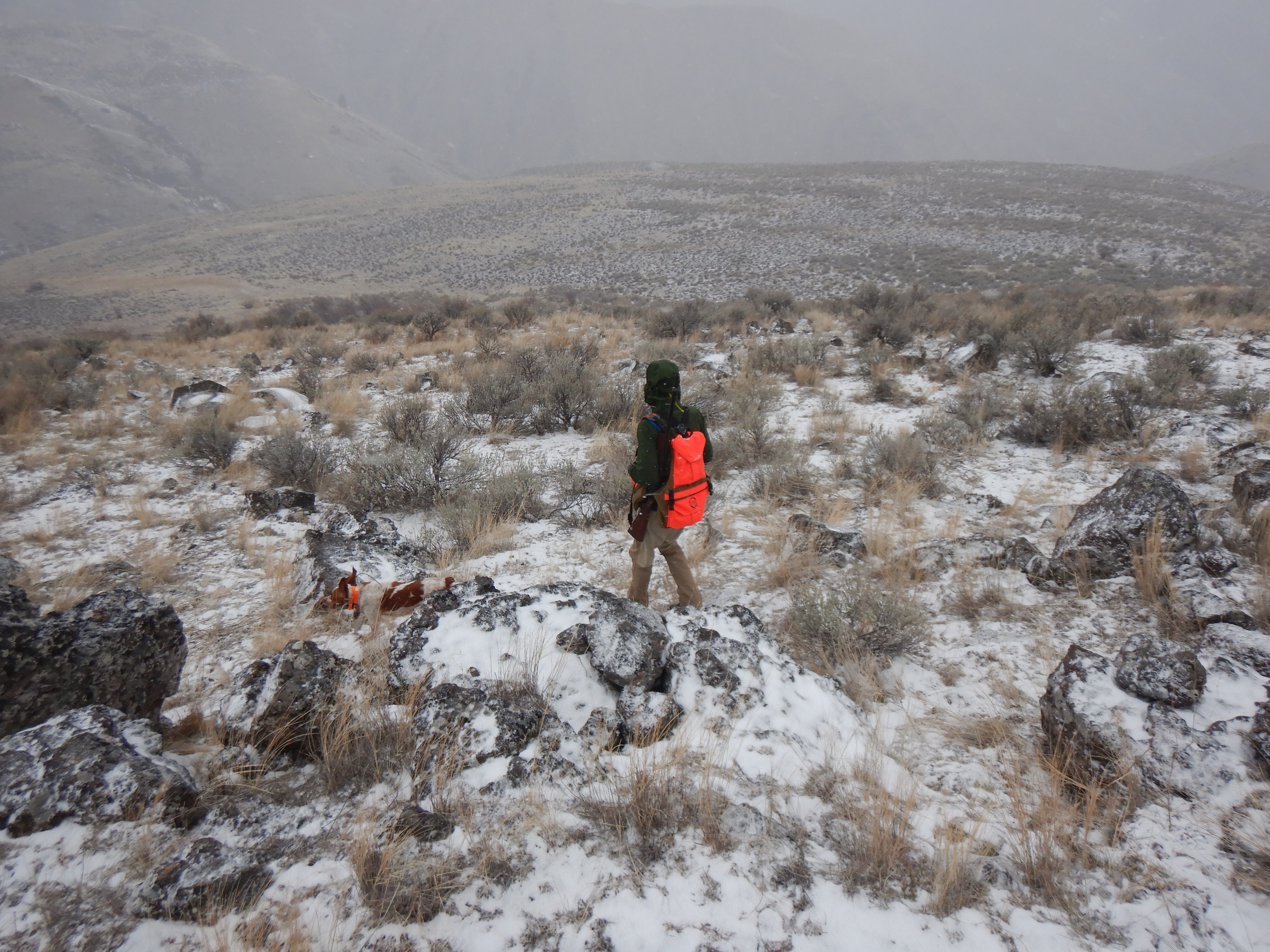
After getting several glowing recommendations for this vest last year, I finally managed to snag one in the off-season. I’ve now used this size M/L Tenzing BV16 since the beginning of the season, for 18 hunts and just about 100 hours. As with all the stuff I review, I bought this vest with my own money and have no stake in Tenzing or any other company. In other words, it’s honest. It’s also my first video review, aside from the comparison to the Badlands vest in the photos and captions below. The bottom line: I’ll leave it up to you. Enjoy the video.
Leslie thinks I went a little overboard with the Chukar Culture patches (we only have 3 left!)Here, the Badlands Upland Bird Vest is laying on top of the Tenzing BV16. In the video, I think I said the Tenzing was about 4″ longer than the Badlands, but it looks more like 5″ or 6″.The Badlands vest definitely rides higher, which is the main reason I think I’m switching back to it, even though the storage capability is far inferior to the Tenzing.Badlands waist belt rides easily on the top of my hip bones.Badlands, side viewTenzing BV16: doesn’t hang down as long as some vests (see my review of the Quilomene Upland vest), but quite a bit lower than the Badlands.Tenzing waist belt, in the upper spot, rides about the same place as the Badlands, but the shell pockets fall much lower.Tenzing’s shell pockets and bird pouch from the side
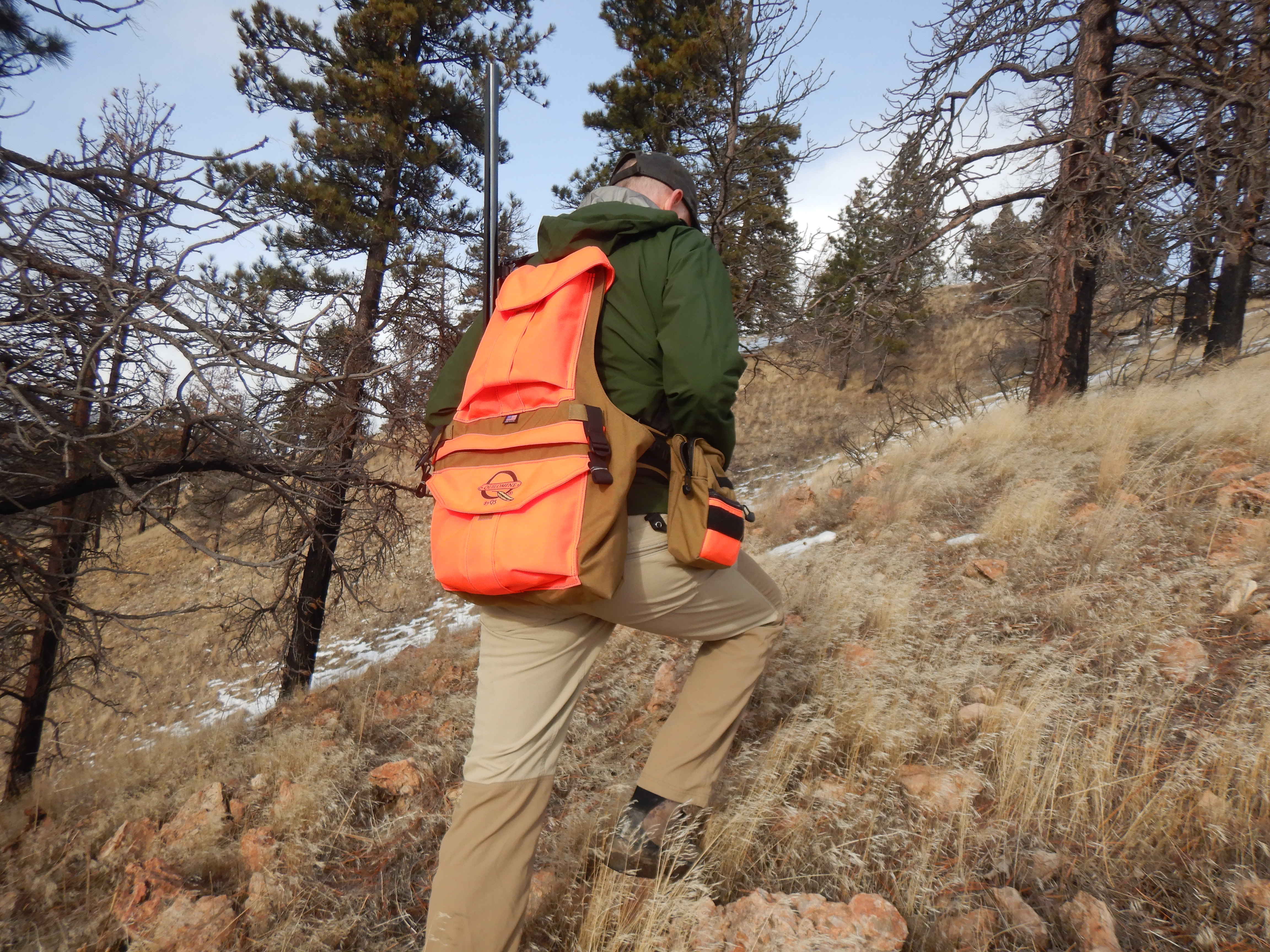
Heading out with the Quilomene Upland Bird Vest, nothing in the bird bag yet
Just before New Year’s my new Q5 chukar vest arrived, which I’d ordered on November 30th: the Quilomene Upland Bird Vest. I’d been using the Badlands Upland Vest (no longer available) for the past couple of seasons and — as the weather asked us to bring more apparel, which goes on and off depending on the terrain — I started finding it just didn’t have the carrying capacity I wanted, especially as the bird bag began being burdened by bigger bunches of birds. The Badlands vest is still my favorite overall vest, but it’s not perfect and I continued to wonder if a perfect vest existed.
So I looked and looked: I looked at the Tenzing BV16 (currently out of stock everywhere I looked), at the Filson Pro Guide Strap Vest (no longer available), the Orvis Pro Series Hunting Vest (won’t work with a hydration bladder), Oregon Pack Works Rogue Bird Pack (not much information and only one photo, and by far the most expensive), and Wingworks Upland Wingshooting Vests (unavailable; I’ve been trying to get one of these for quite a while now). L.L. Bean makes a cool-looking vest, but I tried it a few years ago and returned it after one hunt because the water bladder sat too low in the pack to get it to flow without standing on my head. I’d used the Q5 Centerfire for a couple of seasons and really liked it, but ultimately found it too bulky for my style of chukar hunting, but decided to take another look at their wide variety of upland vests.
On the Q5 site, the Quilomene Upland Bird Vest looked like it might be the ticket: bladder-ready, easily-accessible large bird bag, moderate storage, modular straps (can add/remove accessory and shell pockets), and lash-strap ready for external carrying options. I’m about 6′ and 155, so I ordered the smallest waist belt, and it just fits cinched as tight as it goes; skinnier folks will probably find it too loose.
When I ordered it, the site showed one message saying they were running a 2-week lead time on new orders, and — somewhere else on the site — a 30-day turnaround. I received mine a month after they charged my card. The current message (as of 1/10/20) shows 30 days out and “unable to provide any status updates.” It’s ironic that chukar hunting seems never to have been more popular, yet it’s nearly impossible to get a new vest quickly, and the choices seem to be shrinking. Not sure what to make of that, other than American manufacturing doesn’t seem to be faring too well at the moment; the only two vests I mentioned that are available (the Orvis and the L.L. Bean) are not made in the U.S.
Anyway, I was very excited when the Quilomene vest finally arrived. It took a while to set it up to fit, but once I’d made some velcro adjustments, shortened the shoulder straps as far as they’d go (see more on this below), and added the two shell pockets to the padded hip belt, I was ready to install my 100-ounce Camelback hydration bladder. This wasn’t easy. The bladder pouch is directly against your back (which is moderately uncomfortable when the bladder’s full), and there is a hole on both sides of the bottom of the pouch, intended for the hydration bladder’s hose to exit the pouch for routing somewhere on the vest. The problem with this is that most bladders have their hoses exiting the bladder at an upward right angle; I hadn’t realized this until I couldn’t get any water out of the hose and had to pull the whole bladder out to see what the problem was. No matter how I tried routing the hose through the bottom holes in the pouch, the hose got kinked and wouldn’t flow. So I ended up running the hose up the inside of the pouch and out the top; not a huge deal, and it works fine.
Bladder pouch with hose coming out the topTop of the Camelbak bladder; note the retainer clip: the vest’s pouch doesn’t feature anything to clip it to
Another issue with the vest if you use a bladder is that there’s nothing at the top of the bladder pouch to attach to the top of the bladder to keep it from sloughing down in the pouch as the water level drops. Most bladders have something at the top near the fill point to counteract gravity so the flow doesn’t get interrupted; the Q5 Centerfire did, but this vest doesn’t.
Hose clip sewn into right shoulder strapAfter cutting out the clip; I used a flame to seal the loose nylon threads…
Still another problem with my particular set up is that I ordered a water hose retainer clip, which the Q5 video shows as removable, so I assumed it would come loose and I could put it wherever I wanted. But it was sewn low down on the right shoulder strap. The first problem here is that a right-handed shooter probably won’t want the drinking tube on the right side; second problem is that it’s sewn into the strap and prevents me from shortening the shoulder strap below the clip. I wanted to shorten the straps to get the vest to ride higher, so I had to cut the clip out (more on that below).
The other negatives I’m experiencing with this vest (I’ve hunted with it a half-dozen times now) have to do with the shell pockets. I ordered a standard Q5 shell pocket for my shells, which I keep on the right side and a Quilomene pocket for the left, which looked like it’d be roomy enough for me to carry our small camcorder. It’s not, but it’s bulkier and takes up more hip-belt real estate so that it rides on my left thigh when I’m climbing (very annoying), and requires two hands to open. The Q5 shell pocket holds a lot more shells than I’m used to, which I appreciate, but is not nearly as user-friendly as the substantially smaller Badlands magnetic closure shell pockets; for quick reloading, especially with gloves, the Q5 shell pockets are not easy to manipulate with one hand.
With just a couple birds in the bag, it falls lower on my body than I’d like
The bird bag is really big and easy to get birds into, as long as the storage pockets (which sit on the outside of the top layer of the bird bag) aren’t too heavily loaded with gear, or you don’t have a heavy garment or elk shed lashed to the outside of the bag; if this is the case, you have to push hard backward to gain enough space to drop the bird in the pouch. Without birds in the bag, it rides much lower than I’d like, and when I’ve got a bunch of birds in it, it bangs on the bottom of my butt with every step, which gets old fast. At 6′, I don’t think the vest should hang as low as it does.
Bird bag, secured by snaps and velcro, opens to adjust the strap length and clean out the pouch
So after cutting the sewn-in clip out of the right shoulder strap I shortened the straps a lot to see if I could get it to ride higher so the bird bag doesn’t ride on my rump. I was able to shorten the straps to get the bag to ride below the small of my back and on the top of my butt, but this moved the padded hip belt above my waist: not an option! So it seems the vest is definitely designed to ride as low as it does, which doesn’t make a lot of sense to me, but what do I know?
I don’t hate this vest. I really wanted to like it. At $240, it should be high quality, which I think it is, at least as far as the materials. The heavy-duty nylon and plastic components seem durable, although I do wonder if the very bright blaze sections will quickly fade as they did on my Centerfire vest. It’s been a long time since I’ve used a strap vest, so I wasn’t sure how I’d like the basic no-frill, unpadded nylon shoulder straps, and they’re actually a lot more comfortable than I expected. Ultimately, I just don’t like the fact that it’s designed to ride so low. If anyone’s interested, it’s available for $200, and I’ll throw in a couple of our new iron-on patches.
Our new Chukar Culture embroidered patch
The bottom line is that this — so far — is definitely not my perfect chukar vest. I still haven’t found it and suspect it probably doesn’t exist.
Pros:
Fairly comfortable (aside from the butt-whomping)
Adjustable (within limits)
Good amount of storage capability
Easy to get birds in the bag (as long as you’re not carrying a lot of stuff in the storage pouches)
High quality components and construction
Cons:
Q5 shell pockets not easy to use with one hand
Quilomene shell pockets almost impossible to use with one hand
The Badlands Upland Game Vest is a mixed bag. I wanted to use it a bunch before reviewing it because I thought the things I didn’t like about it might get resolved through familiarity. And while familiarity in this case has not bred contempt, I am probably going to go back to the Cabela’s vest as my go-to bird bag.
First, the good:
It fits like a glove. The vest is contoured nicely and fit me perfectly right out of the box. Over the course of the season, as the weather grew yuckier, it still fit really well with lots more clothes underneath it. It’s very adjustable, too, so fit gets a 10.
It’s very light. At 2.8 pounds empty, the vest is light. Even with a full 100-ounce hydration pack, two boxes of shells, and most of the many pockets filled, I hardly notice I’m wearing this vest. Compared to the other packs and vests I’ve used, including the Cabela’s, it’s much lighter. I think the contoured shape of the vest helps a lot in this regard, equally distributing the weight across the shoulders, back, sternum, and hips. Give it a 10 for lightness.
Hydration pouch is perfect. All the other vests I’ve used have had under-sized or poorly designed hydration bladder pockets. Not this one; it easily fits my 100-ounce bladder even with the insulated Camelback pocket it’s in. It zips at the top (nicer than a Velcro closure), and has good routing for the drinking tube.
Construction and quality are as good as I’ve seen. I really like the materials used in this vest. The nylon panels are strong but not overly heavy or rough; the L.L. Bean vest’s Cordura was like sandpaper. Zippers are good and easy to operate with or without gloves. The magnetic closure on the shell pockets, while initially causing some concern about phantom opening, have never failed and are one of two or three favorite things about this vest.
Now for the things I don’t like about it:
Bird bag is too small. I rarely limit, so haven’t tested the maximum capacity of the bird bag. But with the pockets on the back of the vest holding my hydration bladder, first aid kit, light snacks, and extra shells, getting even one chukar in it can be a challenge. Perhaps the tradeoff from making a super low-profile vest, the bird bag needs another couple inches of clearance to live up to the tag’s claim that it features “the easiest bird access ever developed.” Compared to the Cabela’s vest, bird access is really quite poor, as is one of two reasons I’m switching back to the Cabela’s vest.
Storage space insufficient. For an all-day hunt in variable weather, you will have to modify this vest. Despite the numerous, nicely designed pockets, there’s no room to put any layered clothing, especially a bulky jacket or sweater. Same with extra food or water bottles. The only really usable storage space for bulky items is in the bird pouch, which (as mentioned above) is also a bit too small. The Cabela’s vest has a cheap bungee thing on the back that I could quickly and securely strap bulky layers to; the Badlands vest has a thin elastic cord threaded vertically through the upper part of the back of the vest, which actually came undone the first time I tugged lightly on them. I ended up pulling them completely out of the threaded strips and tied them to the carry handle on top so I could strap a jacket to the vest. Not an ideal setup, but it worked in a pinch.
To be fair, I love everything about this vest except for the two (critical) things above. There are several other good, much more thorough reviews of the Badlands vest that give it a more positive spin, so if you’re considering this vest, check them out: JT’s Upland Blog, and Linton Outdoors.