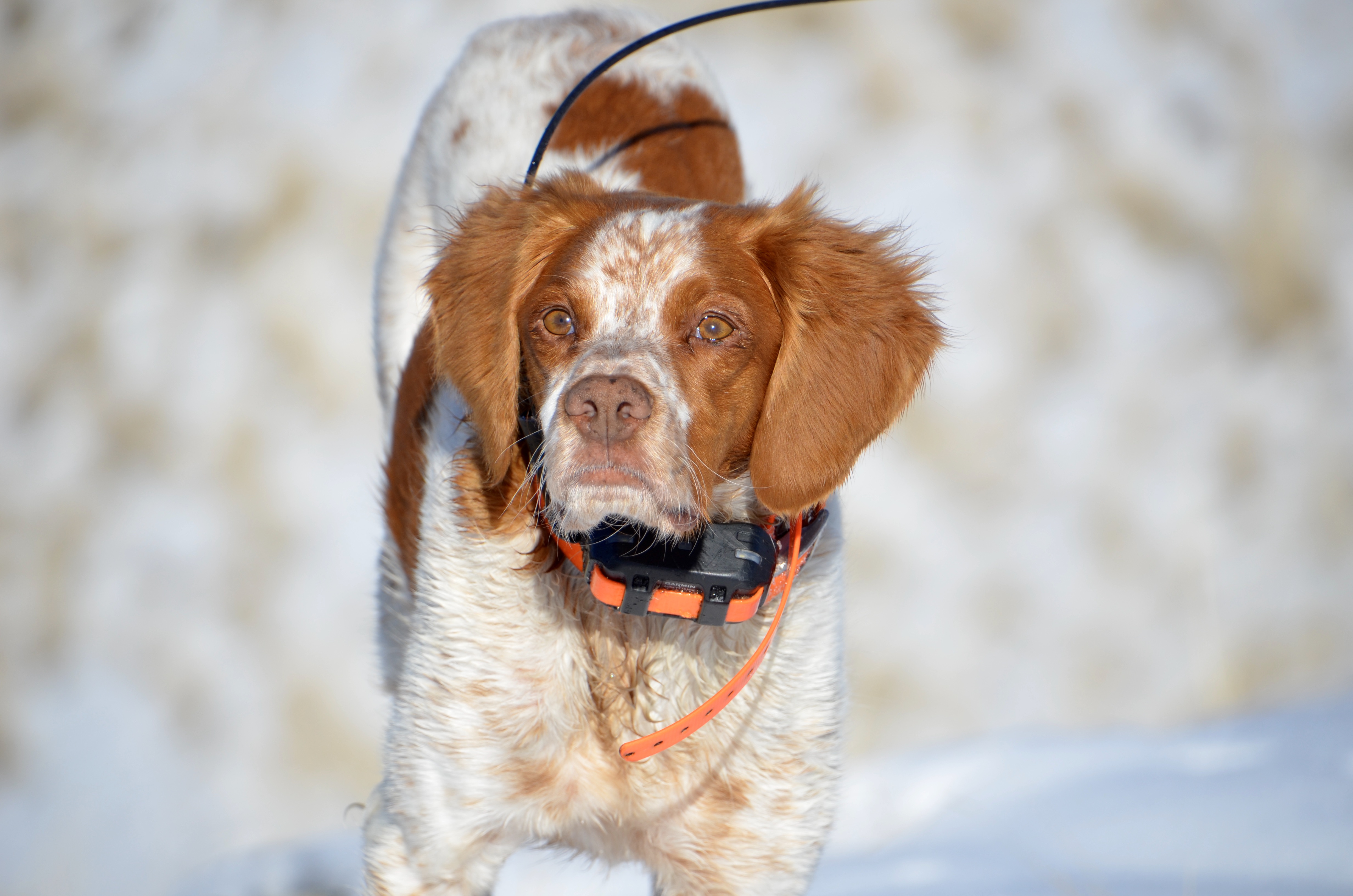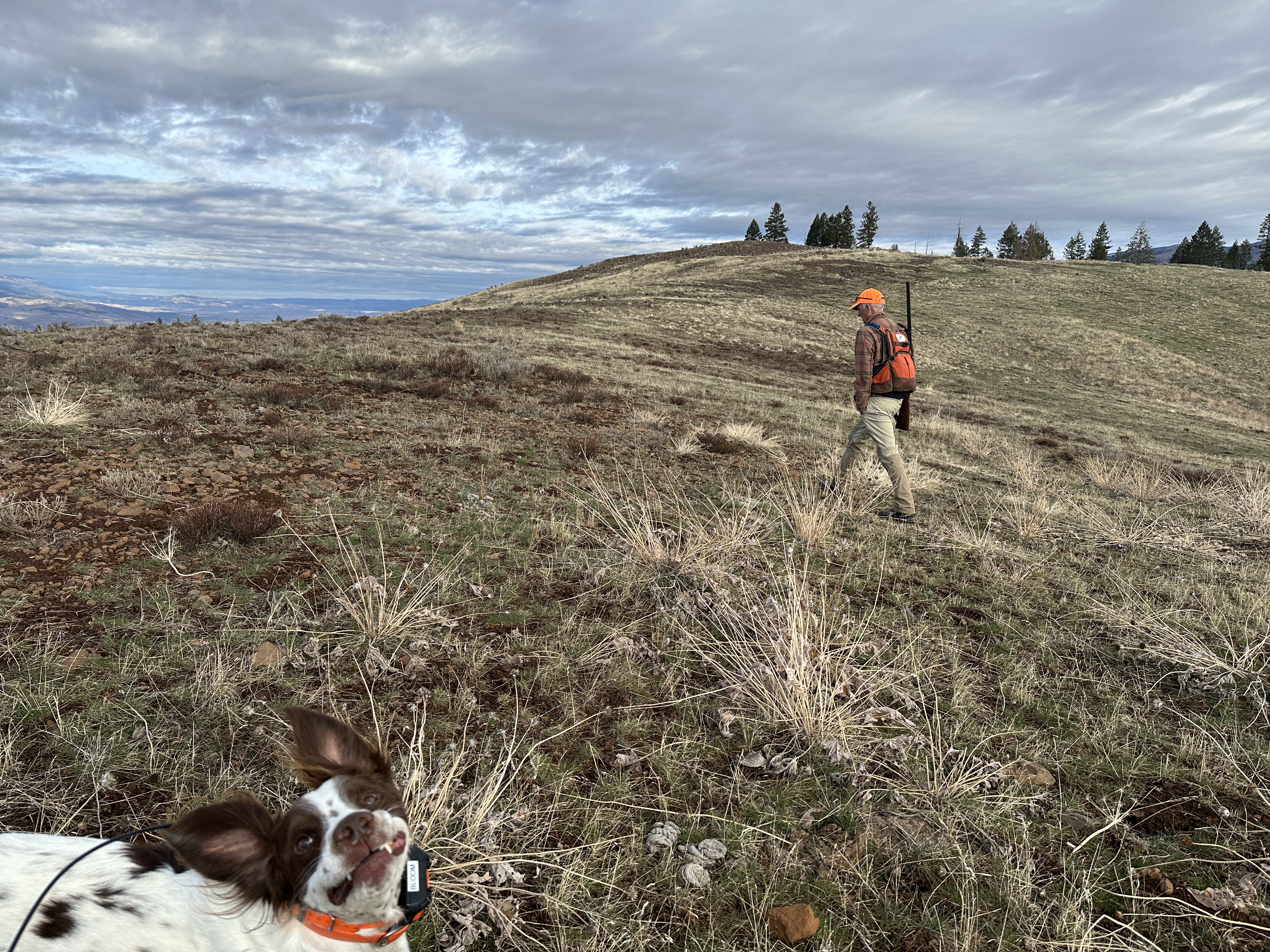
Tag: brittany spaniel

  • Grace

    Grace

    Unmerited favor.

    I’ve gotten out quite a bit so far this season. The weather’s been good. We recently took a trip to what — in years past — had been the best place I’d ever hunted chukar, for many reasons. We’d looked forward to it for nearly a year. But for whatever reason the hunting was terrible. Or I should say that the bird count was terrible; the hunting was excellent as it usually is when compared to not hunting. But in more miles than normal we saw a small fraction of the number of chukar we’d routinely seen in the area.

    Still, six or seven weeks into the season, it’s been good in many ways. Stats. Because of the nerdy log I keep, I can see that — so far — it’s taking me less time, distance, and elevation to bag birds than it ever has (my duration, elevation gain, and distance hiked, however, are significantly down — which I attribute to age; you can’t win ’em all). My shooting started out much better than average but — with yesterday’s atrocious performance, perhaps attributable to our first outing in Hells Canyon this season, on jumpier (probably much more frequently hunted) birds — it’s back down to my “normal” (but still unacceptable) 35-ish percent. Most of the 23 hunts I’ve done this season have been in completely new places, closer to home, found on onX; I’ve looked for public lands that — on the computer — looked like they should have chukar, and every single one of them has, sometimes with very good numbers of birds, and usually these have been places that I doubt many — or any — people have looked for chukar (they tend to be places that a UTV can’t get near). The conclusion that I make from these interim data is that — finally — it seems I’m getting more efficient — dare I say better? — at finding and hunting chukar. I could go on about all this. But…

    A person wearing an orange hat and backpack walks through a grassy field with two dogs, amidst rolling hills under a clear blue sky.
    Pretty over-grazed and overly flat terrain, but we’d never been here and didn’t see sign of others, either. And there were lots of birds. Plausible conclusion: the lack of homo sapiens is a good indicator of game bird presence.

    One of the best things for me this season has been hunting with nearly-eleven-year-old Peat. Five times now he’s chased down chukar that I knocked down, disappearing for quite a while, and come back with them. Yesterday, for the first time this season, Peat disappeared after a bust in which I was able to whiff three times with no visible evidence of having even ruffled any feathers. It was one of those “I can’t believe I didn’t hit anything!” busts. But he came running back to us at least five minutes later with a chukar in his mouth. One of every seven birds I’ve bagged this season has been courtesy of Peat’s hard work after the shot.

    A dog carrying a chukar bird in its mouth, surrounded by rocky terrain and sparse vegetation.
    Peat with the chukar I didn’t know I’d hit

    The Hard Work Before the Shot award will without question go to Bloom. He covers much more ground than Peat does. Bloom averages more than four times what we cover, while Peat does almost three times our distance. Bloom in 18 hunts with me so far this season has run 272 miles, while Peat, in 22 hunts, has covered 237. We’ve noticed that when we all hunt together, Bloom tends to false point fairly often, especially at the beginning of a hunt. He definitely improves as the hunt goes on, but it’s almost like he’s trying to impress Peat, whose favorite thing in life is to honor another dog’s point (see my YouTube channel for many examples of this). Usually, Bloom’s first point of a hunt is several hundred yards uphill from where we’re just getting acclimatized, and we book it up to him, sometimes after he’s been stationary for up to 20 or 30 minutes, and as soon as we get up to him, he bolts. I’ve started calling it a “self-imposed whoa,” which is weird because Angus, who never once false pointed, always pointed with this very un-stylish posture (Angus is Bloom’s great-uncle). But as the hunt progresses, he seems to get more and more solid locating and pinpointing birds, which is really great. He tends to leave the retrieving and tracking duties to Peat, so it’s a good division of labor. I will say, though, in the couple of hunts I’ve done alone with Bloom that he has not false pointed even once, and has been an ideal hunting partner. It’s almost as if he’s trying to tell me that I can still do this when Peat is gone.

    A brown and white dog running through dry grass while carrying a bird in its mouth, with another dog in the background.
    Bloom doing his thing, whatever that is.
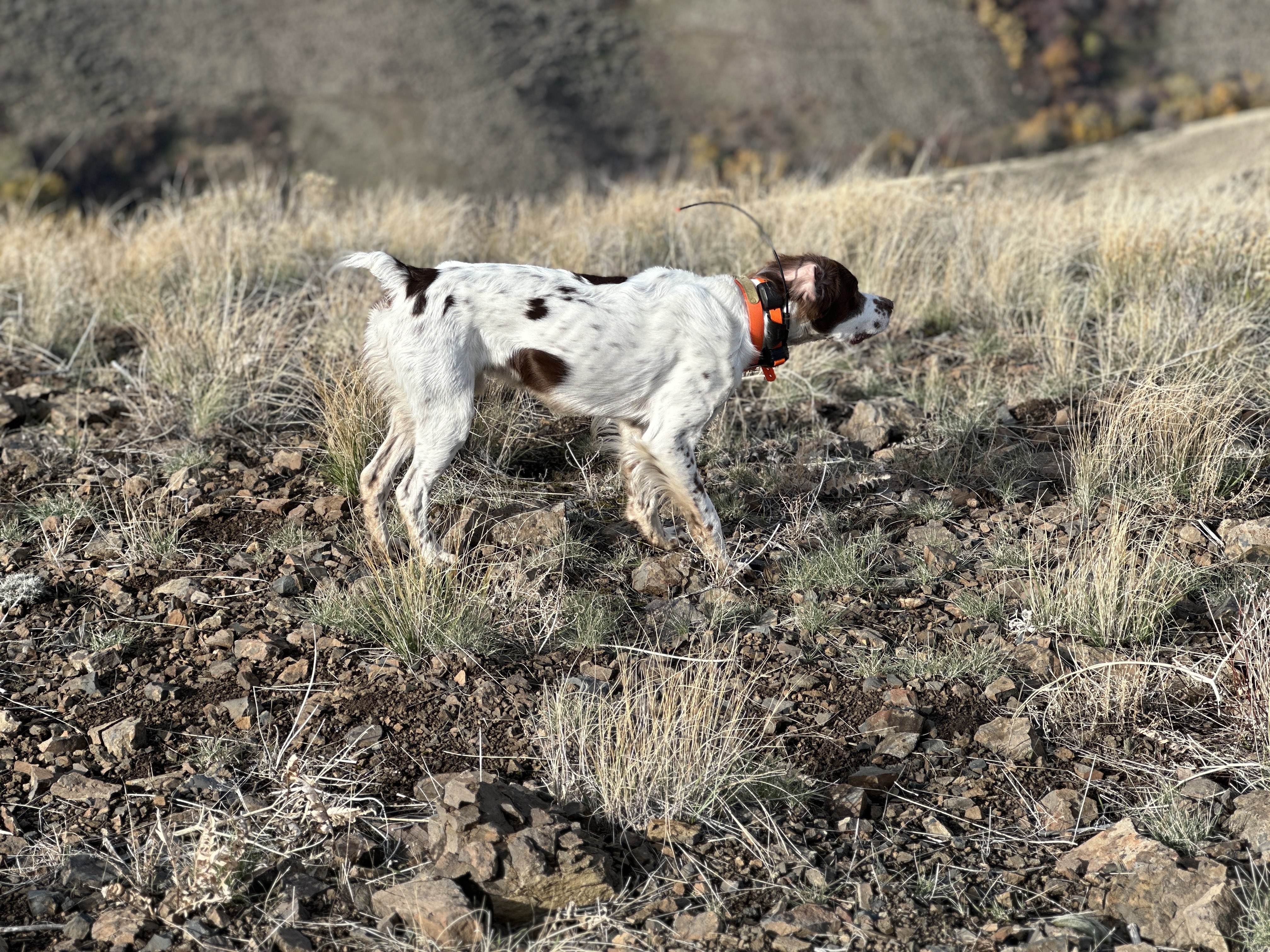
    A dog with a collar standing on rocky terrain, observing its surroundings in a grassy field.
    Bloom’s “self-imposed-whoa” posture
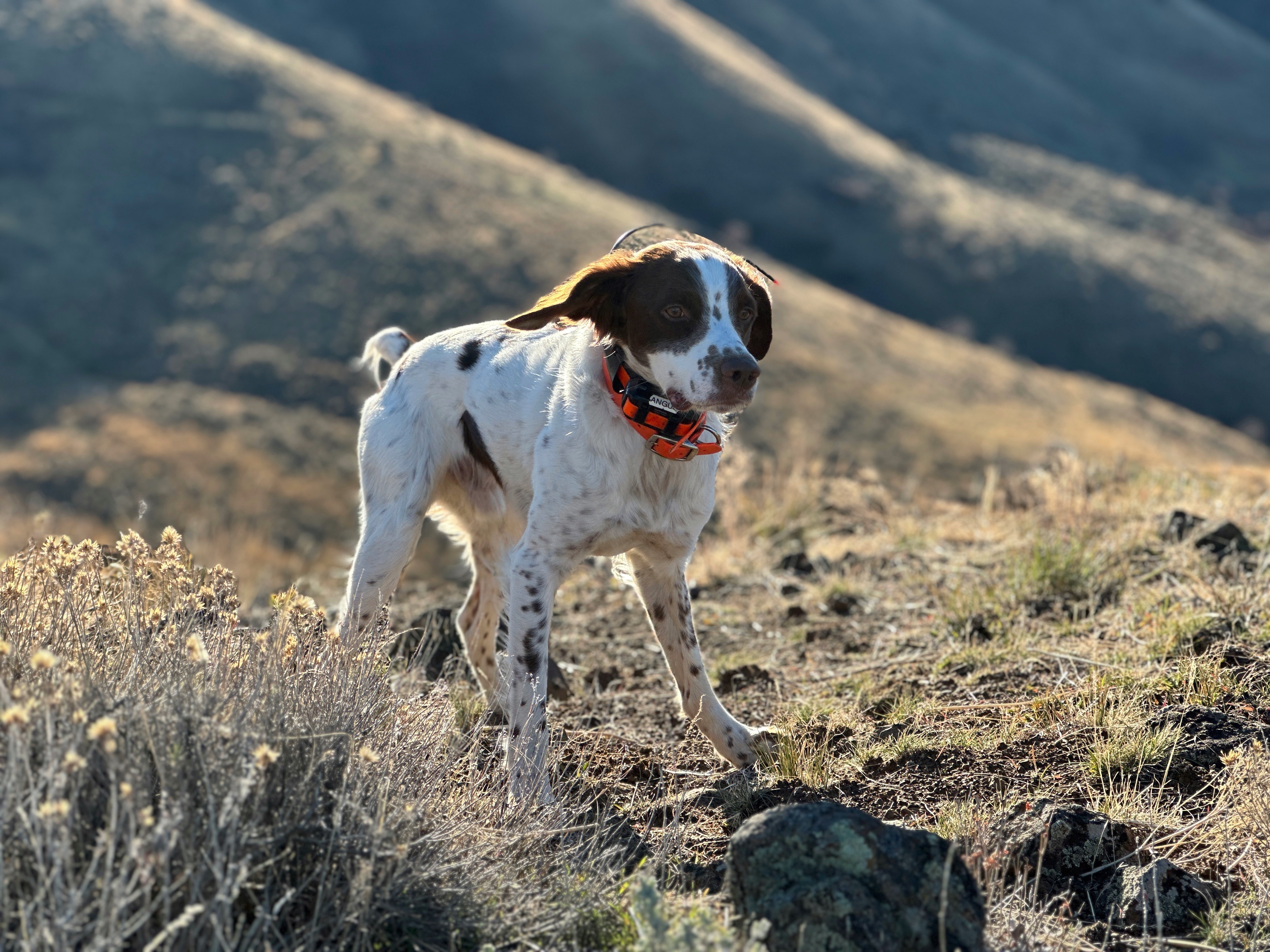
    A dog with a white and brown coat, wearing an orange collar, stands on rocky terrain in a grassy landscape, with hills in the background.
    Bloom in a “real” point (birds were there)

    Maybe the best thing that’s made this season, so far, really good is Leslie. I’m not sure about saying this because I realize it might make me look like much more of an ogre than I think I am, but she’s done two things differently this season than she’s done in the eight seasons since she started hunting. First is insisting I go alone with Peat every once in a while. As I’ve said, that’s been beautiful; I think it’s been beautiful for both of us because she’s gone by herself with Bloom several times and has really enjoyed that. Second is, when we all hunt together, she agrees to go where I want to go, and the discussions about the route we’ll try to take get vastly reduced. I’ll be honest here by saying that the main reason I have liked hunting for the 25 years I’ve been doing it is that when one is really hunting everything else disappears, including language and everything that stems from it. There’s nothing else like that for me (except, maybe, playing music). This, for me, makes it necessarily a solo endeavor. Any “foreign” intrusion on that — whether it’s your wife or best friend or boss or whatever — mitigates the escape from everything that is crucial to liking it, to wanting to hunt. So the thing I think I’m most grateful for this season, among many great things, is Leslie’s realization and appreciation of how and why I like hunting. It’s allowed me, for probably the first time since she began hunting (which was a huge step for her for many reasons), to sincerely enjoy hunting with my wife. I realize her sacrifice here, and that, as I said, I might look bad in the equation, but I’m just trying to be honest.

    A woman kneels in a grassy area, smiling while holding a chukar bird in her right hand. Two dogs are positioned nearby, one is a brown and white dog and the other is a tan and white dog. The background features a mountainous landscape.
    Leslie on a recent hunt

    Finally, the other thing that’s made the season so far very good for me has been the book. Many of you have bought a copy of Chukar Culture: Memory, Dogs, Paradox, and for that I’m very grateful. I’d love to hear what readers think about it, so if you’ve gotten a copy please don’t be shy sharing your thoughts with me. I’m trying to figure out how to market it better, but am kind of stymied there (i.e., I’m open to suggestions!).

    Book titled 'Chukar Culture: Memory, Dogs, Paradox' by Robert McMichael, featuring a dog holding a chukar in a grassy landscape.

    Speaking of merch: hats, shirts, and hoodies are coming soon. I will post here when they’re live.

    Thanks for reading, as always, and may your season be filled with as much world-cancelling experience as you’re looking for.

  • Where They Are

    Where They Are

    [I just found this in my “Drafts” folder. It’s from two years ago when we were still looking for a place back in chukar country to move to. I thought I’d posted it but for some reason didn’t, probably related to a family emergency that, along with the person it centered on, passed about a year ago.]

    We drove nearly a quarter of a million miles looking for birds this season. I don’t have the exact figure. We hiked 51.4, which was at least twice what we did the previous season (I didn’t even bother keeping records), but more than 160 fewer miles than our last big season (2020-21). Those are all the numbers I feel like sharing now. Maybe next year I’ll geek out a bit more on that score.

    At the beginning of one of those long, multi-state drives, in December I think, we left our house at the ultimate northwest point of the contiguous United States and drove nearly 30 miles going 25 mph along the undulant serpentine highway fronting the Strait of Juan de Fuca (also known as the Salish Sea) before realizing that I had forgotten my boots. So we went back and got them. The fog had burned off on the redux. “Worth waiting for, huh?” it seemed to say.

    For years I’d wanted to hunt chukar in Nevada. And never had. So this year, we went down there, armed with some beta from a cyber-friend we ended up meeting for dinner in Winnemucca. We’d reserved a room, on his advice, at Scott’s Shady Court, and when we crossed its threshold we time-traveled back about a half-century. Our suite was big and roomy, and cheap, and the dogs loved it, but there weren’t any grounded outlets so I couldn’t charge all our shit. Anachronism much? Anyway, before dinner at the fabulous (for real) Martin Hotel, we headed to Wally World to buy licenses to add to our Idaho, Oregon, Washington, Montana, and Wyoming bird licenses this season. It was a typical Wal-Mart experience: walk around ’til you find someone who looks like they work there, ask for help, and have them ignore you but walk away and use their radio to ask someone to come to the _____ department and help a customer. The five minutes that elapsed before an associate arrived were spent by me thinking I should have just tried to get my license online. The young man entered the space behind the counter near all the guns and ammo (they lock that up now, too), and began logging into the computer. There was another guy with him, also with an associate’s blue vest and nametag with the smiley face on it. Together they appeared to will the keypuncher’s access to the system. Several minutes and dozens of keystrokes later, the keypuncher looked up for a brief moment, not at me but in my direction, and announced that he couldn’t remember his login information. I looked at him and asked if he could call a manager. “I am the manager,” he replied. The ensuing conversation made it clear that I would not be able to purchase a license at Wal-Mart that evening, but that I could come back at 8 a.m. the following morning when another manager who could probably remember his or her login would have taken over. On the way out I made a brief stop at the customer service desk for a second opinion, which verified the first one.

    At the Martin Hotel, sitting with strangers at the long family style dinner table, before our friend got there, while pretending to peruse the menu, we eavesdropped on our table-mates’ conversation about lining up immigrants, shooting them, and letting them fall into a mass grave. “Where would be a good spot for that?” one of the others asked earnestly. Then our friend arrived, and on hearing the account of the Wal-Mart license experience, was initially aghast but then said that unless we had a physical copy of a certificate showing we’d passed a hunter safety course we would not be able to buy a license in Nevada. It was my turn to be aghast, which I was; none of the other five states had such a requirement for people of our advanced age and inestimable experience. Chock this one up to an overabundance of faith and not doing adequate research: the next morning we drove north out of Nevada, our Silver State Chukar Virginity intact. As we crossed from Nevada into Oregon, Leslie said, “We should call it ‘No-vada.’” [NOTE: We’ve since figured out what we need to do on the license front, but have yet to make it there. Soon, I hope.]

    Like Moses, we wandered a lot in the desert looking both for birds and a new place to live. Wyoming was different for us, and revelatory in several ways. The red landscape around the Wind River range struck us positively, but the prickly-pear cactus stuck our dogs’ feet negatively. Still, after a wonderful morning in and around Lander, we did laundry in Pinedale and talked with an octogenarian man who’d raised ten kids in a log cabin nearby with no running water or electricity; each of his kids had long since graduated from a prestigious university and gone on to do big things. We camped at Ten Sleep Brewing Company, initially setting up in the wrong campground, to be kicked out by a rancher who owned what was the glitzy but empty level concrete pad expensive campground right next to the brewery campground but with no distinguishing signage. We found our sloped grassy/muddy tiny spot not long thereafter, which was okay. Better than okay was being awakened the next morning by chukar calling from a rocky outcropping above the brewery. The dogs were lit running through the network of red arroyos and over terrain that must have registered a lunar difference if they’d even paused for a second to contemplate. I’ve never hiked in anything more beautiful, but no birds were found by us despite a couple hard points by Bloom. On our way out of there, we (I) of course got lost, which I truly enjoy but Leslie does not. An unexpected joy, for us both, was that, while we sat pulled off to the side of the road, a FedEx truck passed us, braked, reversed, and the driver asked us if he could help direct us somewhere. His friendliness and easy-to-follow directions gave me a warmth for humanity. About thirty minutes later, we came to an intersection on the still-gravel road that we wanted to analyze, and — you guessed it — the same driver came past us, stopped, reversed, this time getting out of his truck and walking back to us in case, I don’t know, we might have something as novel as a map to look at (nope; just the “smart” phones). Anyway, he suggested the best route to Cody, and we were on our way, but not before my typical question to strangers in chukar country: “Do you by chance hunt chukar?” He said no, he didn’t have time, which I thought was a good answer, whether or not it was true.

    As it’s no doubt obvious by now, we’re both beerhounds, and the more cynical out there might view our house-seeking/chukar-hunting itinerary as a thinly-veiled excuse to visit brewpubs throughout the intermountain west and Pacific Northwest. Joints including but not limited to ones in Prineville (OR), The Dalles (OR), Walla Walla (WA), Lewiston (ID), Clarkston (WA), Ontario (OR), Mitchell (OR), Ten Sleep (WY), Sheridan (MT), Lewistown (MT), Ennis (MT), Victor (ID), Spokane (WA), Baker City (OR), Enterprise (OR), John Day (OR), Salmon (ID), Driggs (ID), Olympia (WA), and Troutdale (OR) sold us IPAs. And, in the ill-fated Winnemucca leg, we were gifted with some fine brews by Alectoris Aleworks! With Hells Canyon Beer about to embark on its third iteration, we realize we actually might be a Beer Club with a Chukar Problem.

  • Younger

    Younger

    Just got home from a great week hunting chukar in Oregon. We were blessed with mostly good weather, and my shooting actually seemed to get better. Imagine that. To be honest, I’d switched from the #7 steel Rio shells (1-1/8 ounce, 1350 fps) that were sent to me in error last season (I’d ordered #6, but they wouldn’t take them back) to some lighter target #6 steel loads (1 ounce, 1365 fps) I’d brought as backups. Who knows? Biorhythms? Planetary alignment? Jerky? Payday bars? A penchant for Joni Mitchell?

    The revelation of the week, for me, came accidentally. Peat, who’s now nearing 10, is wearing out and it breaks my heart. He was limping badly from some abrasions on his pads and also the arthritis or tendonitis that has crept up on him the past few seasons after tough hunts. To call this an accident is dishonest, but I’m still gonna call it that. I was hoping to take Peat for a fourth straight hunt, seeing as it would have been our last day on this trip. But he wasn’t up for it. He didn’t even get off the bed in the camper when I walked out the door with Bloom. Leslie had very kindly encouraged me to go alone with the younger dog. Her dog.

    I didn’t have high hopes for the hunt. I’d never hunted alone with Bloom, who’ll be 4 next March. His nose has always seemed to be almost too sensitive, leading — we’ve theorized — to lots of false pointing. But he’s also found us a ton of birds. Peat, whose favorite thing in the world has always been backing another pointing dog, and, as Angus did with Peat in his early days, seems to have gotten comfortable letting the younger dog do the most work. My log shows Peat barely outrunning Bloom their first season together, then Bloom besting Peat by about a mile or two per hunt, and this season so far (after 17 hunts) Bloom is outrunning Peat by 3 or 4 miles. Bloom is an athlete, a freight train of uncut and solid muscle, and runs 4 to 5 times what we hike. Peat’s a finesse hunter, and has always “only” averaged about 3 times our mileage. The upshot of the discrepancy in the ground each dog covers is that I’d never really paid careful attention to how Bloom hunted, only noticing that he covered much more ground than Peat did. Still, when Peat points it’s a sure thing. I’d gotten used to 50-50-ing Bloom’s points, and focusing mostly on Peat.

    But hunting alone with Bloom the other day let me see him work more clearly. Before too long, it had become obvious how utterly methodical he was. He’d almost intuit the path I moved along, and would run ovals apexing at almost exactly 200 yards in front of me, then circle around just behind me and start another oval. He did this for 3 straight hours, deviating only when chukar scent pulled him “off” course. Which happened five times, resulting in four shots and three bagged birds. My “best” hunt (as far as numbers go) this season.

    Bloom seemed to appreciate the simplicity of our hunt, too. He didn’t have two hunters and another more experienced dog to contend with. It was reassuring, in a bittersweet way. It was almost as if we both responded to being able to focus better on the task at hand, where the sum of the affair was greater than its parts. How sweet. But the bitter part remains. Anyone who’s had multiple dogs knows this game: you favor a certain dog and then he or she starts showing the inevitable decline that comes with age. The cloud moves in. I’m at the point where I can, finally, hunt more consecutive days than Peat can, but I know it won’t last long, both because of my age (And if no other misery yet age?) and because of his. We look for things that might mitigate this sadness, and a younger dog improving, or just being able to appreciate him without comparing him to an older, more beloved beast, certainly doesn’t hurt.

    I’m glad Leslie encouraged me to take her pup out, and that she sacrificed a gorgeous late October day (the day before her birthday no less!) to stay at camp with Peat.

    Bloom pointing stylishly (note his tongue). He seems to like it this way.
    Just checking to make sure I’m still there
    Bringing home the bacon
    Bloom’s most similar behavior to his great-uncle Angus: retrieving a bird to the closest sagebrush shade to me. He runs hot.
  • Will

    Will

    Will you go to lunch.” — Kevin Spacey as Williamson, Glengarry Glen Ross

    If others have their will Ann hath a way.” — James Joyce, Ulysses

    “Jem and I were accustomed to our father’s last-will-and-testament diction…” Harper Lee, To Kill A Mockingbird

    The will to live, which forms the inmost core of every living being, exhibits itself most conspicuously in the higher order of animals, that is, the cleverer ones…” — Arthur Schopenhauer, “Psychological Observations” (1817)

    I had this thought last night: “There are four dead birds _________ in my refrigerator.” I couldn’t think of any present participles. Actually, I could, but they didn’t make any sense, their cognitive dissonance was too great. The idea doesn’t really need a participle but, you know. Habits of language. Then I wondered why I was having this trouble. And it occurred to me that death can not be a state of existence that warrants any present anything, participles, verbs, presence. It’s the absence of being.

    I would say that chukar are among the “cleverer” animals, so when their will to live is extinguished by a mortal wound caused by some number 6 steel shot fired from my gun, that bird is from that point forward verbless, regardless of whether it’s in my fridge or freezer, or even taxidermied on a beautiful mount that hangs on the wall. Its being no longer is, which includes its will to live. Or, as John Cleese described his dead parrot to the falsely incredulous pet shop owner, “This is an ex-parrot.” And I did that.

    This all might seem pretty basic. But it wasn’t to me, and still isn’t. The problem intensifies, of course, when it’s turned onto me and my mortality. What’s the connection between all of our individual mortalnesses and this hobby of ours, trying to bag birds, trying to create ex-chukar?

    The phrase in the regulations sheds some light on this: “reduced to possession.” When we will it and execute it properly, the chukar’s will to live (our idea) is not actually reduced, is it? Instead, it’s eliminated. But what the regs mean is that — like the word they also seem to love, “harvest,” as if we’re talking about corn here — we’ve merely diminished the animal’s state of existence. One could also argue that the regulations’ language here simply marks the difference between a daily bag limit and how many previous days’ harvest one has in possession. Regardless, it’s dishonest language. The discrepancy in meaning between “reduced” and “eliminated” is our (as the putatively cleverest of the animals) inclination (or will) to minimize or obfuscate the fact that we’ve asserted our will over another creature’s and rendered it a former being. Further, it’s generally assumed that asserting our will over another creature’s — as long as they’re “lower” than us — is normal, okay, unproblematic. Ortega y Gasset’s Meditations on Hunting, probably the most-cited writing on this subject, normalizes this hierarchy in a specist and specious argument (which is why I have no use for it).

    Another aspect of the phrase strikes me, too: “possession.” When we possess the chukar, it’s not only dead but no longer free. We own it. But can something dead be owned, possessed? Grammar says no. Still, our will prevails. (I’m aware of my cultural bias here, as a non-Native Western European: Native American cosmology and ontology have much different takes on all this.)

    But, despite the linguistic obstacle, who can do this to us? How are we reducible to possession? That’s not a real question. We all know the myriad answers to it. Some eliminations are accidental, some intentional, and some just are as a matter of course (dying of old age, for example). Or, for some, it just comes down to God’s will. Not sure what to do with that, aside from saying that we’re assuming the status of God when we “harvest” game (Gasset would have no problem with this). But it’s ironic to me that we cleverest animals have mucked up our wills to live far beyond the less clever but still clever enough to will a life. Maybe in Schopenhauer’s time humans’ will to live was pretty uniformly “conspicuous.” Existence was harder then, and humans, regardless of economic or social status, spent enormously more time than we do on subsistence-related endeavors. Food, shelter, clothing. Now, we have Amazon and Blue Apron. So our wills to live have been diminished somewhat, at least for those privileged enough to have a relatively easy life. I’d say that anyone who hunts for sport (as opposed to necessity) falls into that category.

    If you’ve read this far you’re probably going, “Where the hell is he going with this?” For me, all this comes down to the question, Whose will to live shall prevail, and why? Clearly, we humans think our wills are superior to animals’ and therefore, duh, shall prevail. But I don’t actually buy that, although — hypocrite Me — I act on it at least fifty times a season. First, the concept of superiority, or hierarchy, is entirely ours, which is self-proving. “Fair chase” is probably the best known and most relied on ethical justification of this hierarchy, but in truth there’s nothing even remotely fair about it. It’s not a level playing field. Animals have no conception of the food chain, despite being programmed to fit in the various slots human analysis has constructed through observation over the millenia. This reminds me of the trouble Noah Lyles got in during the Olympics for criticizing the “World Champion” concept in American professional sport for assuming the U.S. equals “the world.” So yeah, bias is a bitch, and hackles will be raised when it’s called out. So I expect something.

    A lot of this has to do with my metastasizing distaste for tailgate shots, which I wrote about not too long ago. “Look what I did!” Poses with dead game and their killers litter social media. Despite what Gasset says, there is nothing noble about “tradition,” which has been used for nefarious purposes forever. Why the need or desire to associate oneself with an ex-chukar and share it with the world. Penance? Pride? A cry for absolution? Atonement? Adulation?

    When I kill a bird I feel guilty as hell. I think of the family I took it from. I think of the life it was endeavoring to live, the succulent blades of grass I found in its crop as I cleaned it (the vocabulary of all this rocks me). I think of the covey bust and its communal expression of the will of each of its members to live, and live together, going forward, fearing the demise of their lives, of being eliminated, of not wanting to be eliminated. I think of fear as a killer and a saver of life, and the crap shoot as to which it is in any given situation, and how my participation in this particular situation radically influences that outcome. I think of the things I share in the chukar’s fear, of my own fears about mortality, whether caused by an external force or not. I think of the dogs, and then I can barely take it, in good ways and bad.

    And I will do this. Until I won’t.

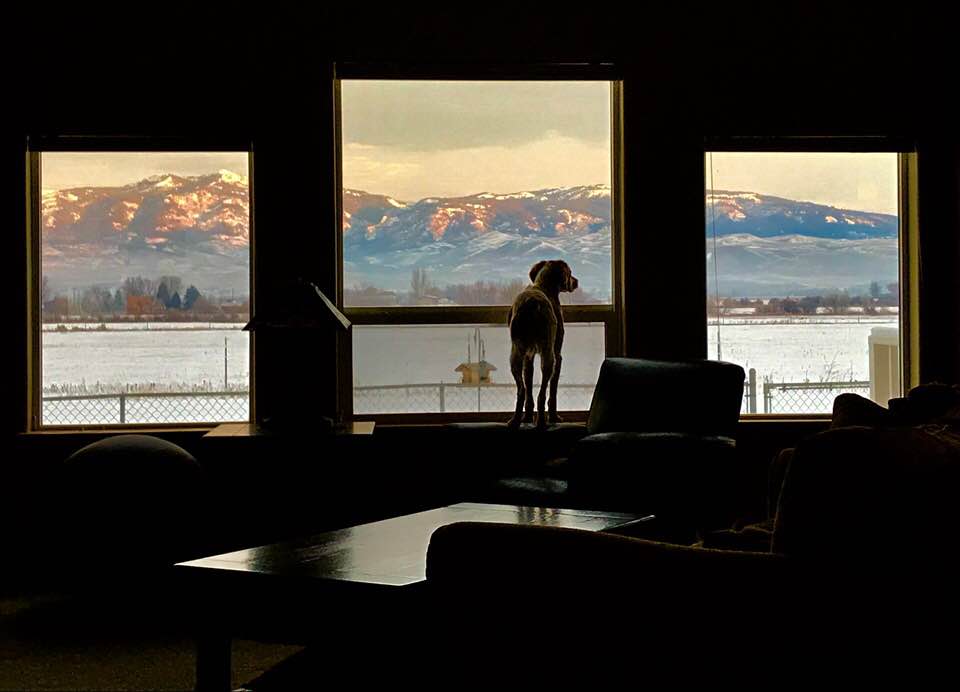
    Peat looking outside in Cambridge

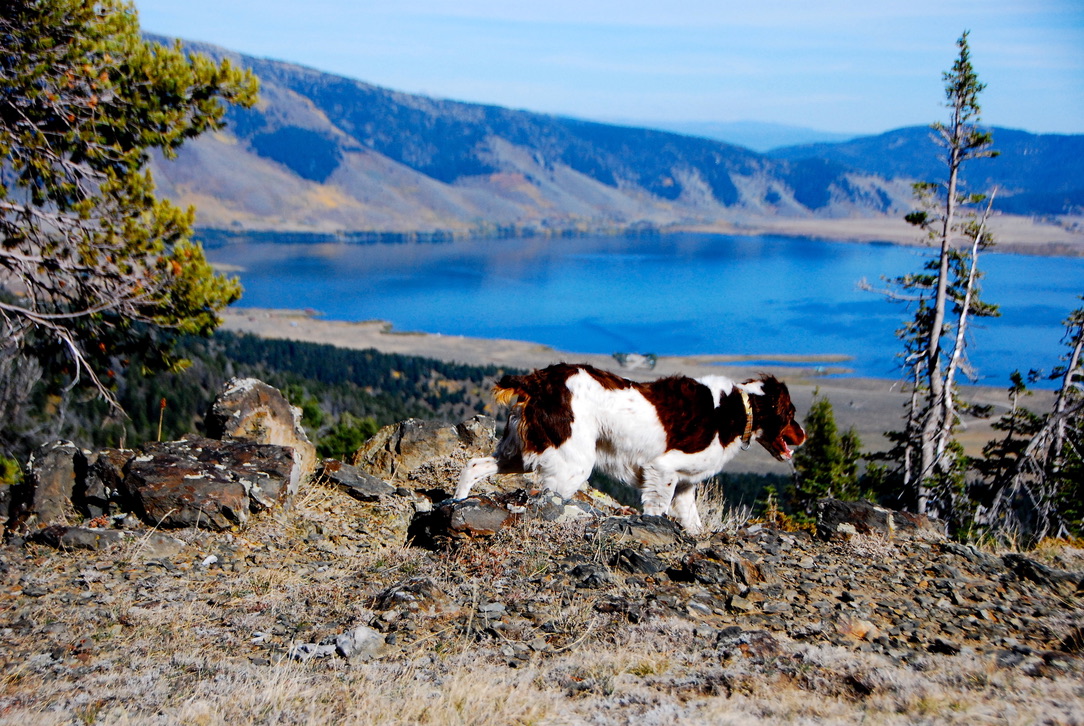
    Angus, about ten years before we laid his ashes in exactly this spot, on Schoolhouse Ridge, overlooking Henry’s Lake, on the Continental Divide.

  • Praising Canines

    Praising Canines

    Our little burg has a “town square” group on Facebook. Notices of dogs running loose, accompanied by blurry photos, is probably its most common theme. Often, follow-up posts report that the mystery dog’s owner has been found and that the dog has returned safely to its home. Very occasionally, as happened yesterday, someone reports a dead dog. A close-up of creamy and mocha short-haired fur, a Christmassy collar with little bells on it, and lots of small black and white-tipped porcupine barbs. No face or even an indication of breed. Not necessary. Someone’s beloved pet, judging by the remarkable collar. Most people who respond do so empathetically, posting a “sad” or “caring” emoji. Sometimes the keyboard commandos come out, though, as one did in this case, chiding the author of the post for not including a “better” photo of the whole dog. But when it comes to dogs, the better angels win and these j-holes get put in their place publicly. Which is gratifying in a way because people seem compelled to affirm that these creatures really are our best friends. You get it.

    I was a cat-person, childless, until age 36. My first dog was Glenna, a backyard breeder’s last Brittany puppy out of a litter of ten. I think she cost me $300. After she passed at the early age of 10 from megaesophagus I tracked her life’s vet bills (I’m one of those organized OCD types): it was more than $10,000. If I’d never gotten another dog after her — the thought had settled in me for a while there — I wouldn’t be writing this. My time with her would have been written off as a failed experiment. Glenna was a good test for a first dog: headstrong, increasingly irritable as she aged and was overtaken by her discomfort from having an esophagus that went on strike: her food just piled up in her throat, created a lot of foam, and the bolus (a word I’d never heard of before this) would get coughed up spectacularly in stages, piles of sticky white foam surrounding still-dry kibble. Gruesome, and emotionally wretched. The pounds slid off her and I finally had to end her life.

    Fortunately, we’d gotten Angus when Glenna was 7. If you’ve followed this blog, I don’t need to say anything else, but you might want to see Leslie’s post from 2019, “Saved by a Dog.” Then, later than we should have, we got Peat when Angus was 8. But if we hadn’t gotten him then, we wouldn’t have, and we might now be dogless. I was convinced Peat was the Devil. Initially. Well, for about three years. Now that we’ve had almost ten years to adjust to him (he hasn’t changed at all), he’s just adorable. At least we think so. Maybe our lack of friends has something to do with that. Peat. My nephew put it well when introducing Peat to a friend of his when we were all about to float the Missouri this summer: “He’s a 10-year-old that acts like a 2-year-old.”

    Now we have Bloom, who’s 3. Bloom, Peat, and Angus all came from the same breeder. They each couldn’t be more different from the rest. Each has been the world. Bloom, by design, is more Leslie’s dog. I’ll let her write something much better than this about him. She has the knack, and he’s worth some buckets of words.

    Peat and Bloom hunted with, for, us yesterday. It was hot. Early season, where there’s no water anywhere and we might as well have been in the Australian Outback. Within the first five minutes, Peat pointed a covey of Huns. Bloom pointed something else, closer to me, about 50 yards away. Peat’s covey went up and Leslie took one shot, killing two birds. Bloom’s birds didn’t materialize. Halfway through the hunt, both dogs started slowing down, hop-scotching from bitterbrush to sage in search of shade. We took a break, gave the dogs some treats to go with the mass quantities of water they’d been drinking, hoping they didn’t get hyponatremia. I ate a Payday. We did a 180, and the sun was, finally, at our back. Peat got a second wind and hunted hard all the way back to the truck. But we encountered no more birds.

    I probably have a few more seasons with Peat, and each will be diminished somehow. If I’m lucky. I can’t really face it. Don’t want to. Yesterday tried to get me to glimpse the future. When Angus was a puppy, even before I started really hunting with him (I had to wait for Glenna to die, when he was 3), I’d begun grieving his death. It was stupid, but that’s what I was called to do with him. Peat guaranteed I wouldn’t do that, and before I knew it (he was a little more than 3) I was hopelessly in love with him. I’ve never experienced anything like it. He’s a cartoon. There’s nothing remotely noble about him, and he doesn’t give a shit. I suppose, then, he’s like me.

    But I do give a shit. That’s what makes him better than me. I shouldn’t. Dogs do that: no matter what they’re like they make you wish you were better, wish you were more like you think they see you. If you give a shit, that means there’s something not quite right with you. Dogs don’t have that burden. They just want to connect. That’s all that matters. Thank god. Dog.

    Glenna teaching the puppy Angus about sticks
    One of my favorite shots of Angus
    Leslie taking a break with Bloom (wearing Angus’s collar)
    Peat looking at the future (Bloom)
    Peat. MENSA Dog.
    Leslie and Angus in a happy place
    Peat, pointing with a tibia, and style
    Spring in Cambridge with Angus and Peat
    Peat, in my classroom, showing Angus where chukar originate