Tag: bird hunting

  • Landmarks

    Landmarks

    I’m seduced by landscapes. I’m enthralled by them.

    Camping next to the Missouri River in Montana for most of the summer, Bob quietly tied fly-fishing flies while Angus slept near. A book sat on the table, a gift that arrived in our mailbox shortly before we left Idaho, given to him by a close friend. Not planning on looking at the book because I had brought along other things to read, I picked it up, thumbed through it, and immediately became obsessed with it. The beautifully written Landmarks by Robert Macfarlane is a gorgeous book on the language of landscapes and nature. It’s a collection of words drawn from dozens of languages and dialects of the British Isles to describe land, nature, and weather. It’s a passionate defense of nature as well as the importance of reflecting nature in language.

    The book’s epigraph resonated with me and I’ve been unable to get it out of my head. “Scholars, I plead with you, Where are your dictionaries of the wind, the grasses? ” Norman MacCaig (1983)

    There are too many definitions of words in the book to pick my favorites, but one that I like is zwer, “the whizzing noise made by a covey of partridges as they break suddenly from cover. “

    Robert Macfarlane writes, “Without a name made in our mouths, an animal or a place struggles to find purchase in our minds or our hearts.”

    The Oxford Junior Dictionary chopped words when reprinting its latest edition. Words like beaver, heron, minnow, dandelion and willow are now gone and they added chatroom, cut & paste, voicemail, and biodegradable instead. According to recent studies from The Nature of Americans, children are spending less time outdoors and in wild places.

    We need to keep the words for the wild things. We need to make sure we never forget these words.

    The swirls in the snow made by grasses blown by wind: anemographia.

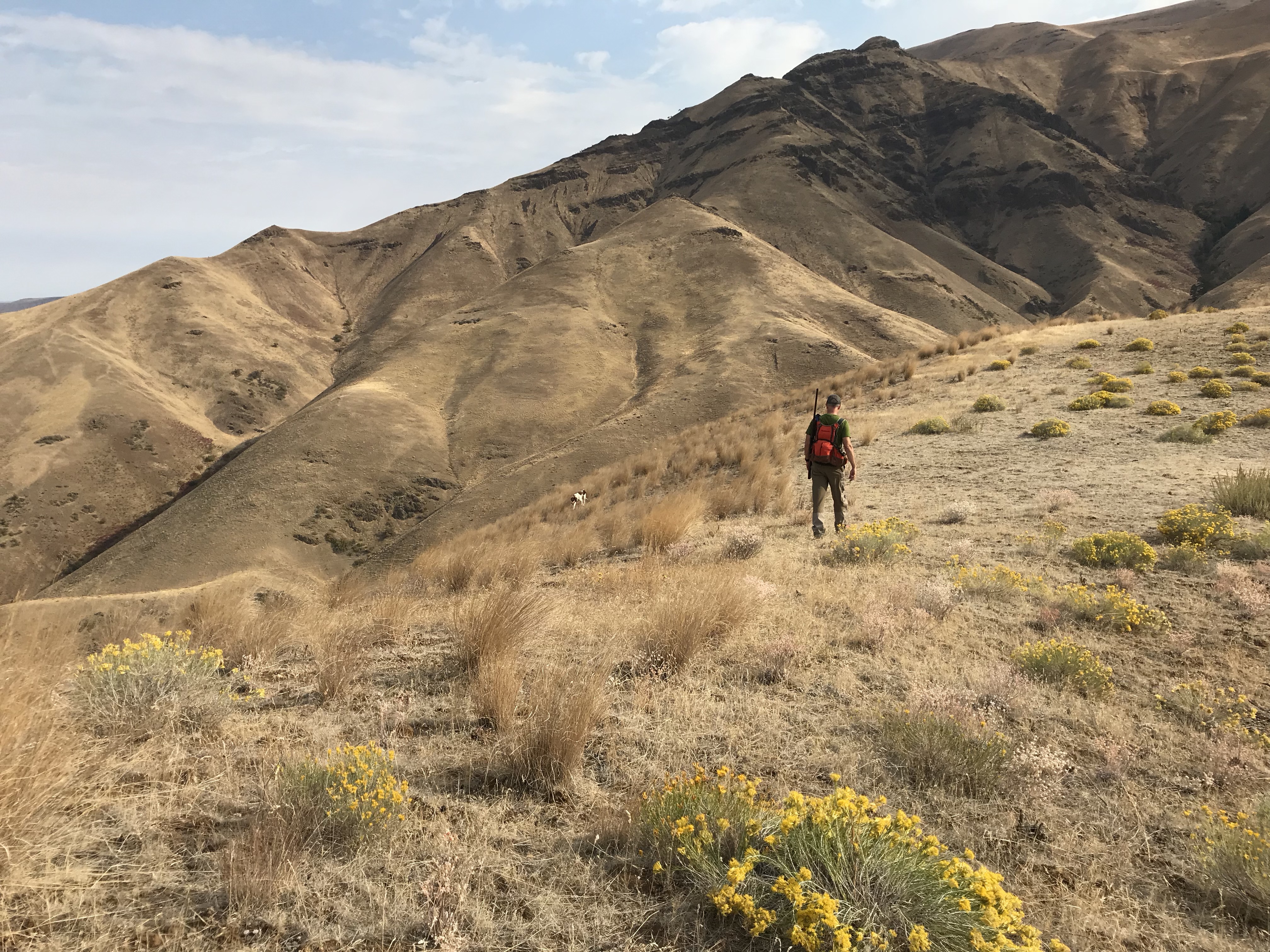
    While out upland bird hunting up and down the steep mountains, I get easily distracted. I’ll take my gloves off to touch with my bare hands the rough surface of the basalt rocks covered in patches of lichen shaded rusty orange and bright chartreuse green. I’ll gaze up into the sky to watch the bald eagles or red-tailed hawks catching the wind currents. I’ll push my way through the wild sunflowers with their brilliant yellow and delicate petals. I’ll slalom through the sea of sage with their three-lobed silvery green leaves, grabbing them in handfuls and pressing them up to my nose to inhale the bitter and earthly fragrance. I’ll stop to look at the knee-high dry grasses in the late autumn that show signs of new life as blades of green poke up through the dirt. In the winter, I’ll stop and look down at fresh snow and examine the swirls that the grasses made on the surface on a very windy day or admire the hoarfrost on a cold morning hunt.

    During these moments of admiring the wild things, sometimes I forget I’m hunting and trying to keep up with the dogs to look for birds. Maybe I’m hunting for the wrong reasons or maybe I’m hunting for the right reasons? Maybe I’m hunting something other than birds.

    Magical point. Hoarfrost: deposits of ice crystals on objects exposed to the free air, such as grass blades, trees, or leaves
  • New Kid on the Block

    New Kid on the Block

    The culture of chukar hunting in our neck of the woods is pretty evident all-year-around. Go to one of our fall 8-man home football games or a local cross country meet and you’ll see your share of Chukar Culture hats on the sidelines. We’re wearing them, parents are wearing them, the out-of town Virginians who come here every fall to hunt are wearing them, and the kids who think their English teacher Mr. McMichael is pretty cool and want a Chukar Culture hat just like he wears are wearing them.

    We’ve given more hats away than we’ve sold; it’s okay, we’re not selling hats to make money anyway. The students are curious about chukar hunting and have gone through four years of high school living vicariously through the adventures of Peat and Angus.

    One kid, a local 12-year-old, who completed the hunter education course a couple of years ago asked us to take him bird hunting this past weekend after hearing stories about Peat and Angus from his older brothers. We’d taken kids hunting before and the theme it seems when we pick them up at their home is that they’re usually not wearing terrain-appropriate footwear. We’ve had kids tag along with us wearing anything from colorful moon boots, rubber rain boots with no traction, or sneakers. The new kid yesterday, was wearing his Mom’s old running shoes.

    We hauled the new kid up and down steep hills yesterday in the pouring rain looking for dusky grouse in the big stands of pine trees next to the sea of fragrant wet sagebrush. We all got drenched, and Peat and Angus were soaked to the bone and covered with stickers. We found lots of birds down in a deep draw but the uphill climb back to the pickup was challenging even for me in this early season. All of us were tired and wet but the kid never complained, despite the fact that his feet were soaked and he’d been slipping up and down the hills in them all morning. Like his older brother before him, he was a bonafide trooper. He asked lots of good questions about bird hunting, and hopefully he’ll want to tag along when the chukar season opens soon.

    Grouse tree and the kid
    Looking for a way up through the thick brush

    On the drive home, we asked him what size shoes he wears, but kids’ feet grow like weeds. This week they’re a size 6. We’ve got a crap-ton of old boots on our shelves in the garage, sizes men’s 9 and women’s size 10. We save our old boots as back-ups just in case, but usually they just gather dust until we eventually donate them to the thrift store. I wish some of our boots would fit the kid. We can take care of getting him a hunter orange hat to wear in the field but if any of you out there have any smaller sized, old boots also gathering dust could you send them our way?

    The kid was still smiling at the end
  • Autumn Child

    Autumn Child

    When Peat was 7-months-old, we took him hunting with Angus to a place where his day of hunting lasted exactly 15 seconds. Upon arriving to our hunting destination, we let both dogs out of the pickup and before we knew what was happening we saw Peat streaking a 200-yard beeline to a covey of Huns that were hunkered down in the sage. Standing next to the pickup, we watched in horror as he flushed them before we could get there and then he proceeded to chase them for another 200 yards. Bob was furious and immediately banished him to the pickup and into his crate of shame for the remainder of the hunt. He sat there, staring out through the metal grates wondering what he’d done wrong.

    Yesterday, I took our old Jeep out for a long drive with the dogs on dusty, washboard, gravel back roads near that place with them bouncing around in the back and thought of Peat and his rough start into the world of hunting his first season. If you’ve been following this blog since we got Peat, you’ll know what I’m talking about.

    The following video is a tribute to the dogs. Most of us wouldn’t be doing this compelling sport if it wasn’t for them.

  • A Walk for Chukar

    A Walk for Chukar

    The landscapes where the birds live dictate where you’ll hunt chukar in the West. Terrain covered in sagebrush, bunch grass, scree veins, and rocky talus outcroppings high up in the clouds is typical in this part of Idaho. You’ll encounter steep traverses and sidehilling that make you wish you had tightened your boot laces tighter. Later in the season, in December and January, it gets snowy, icy, and slick which slows you down especially if you have to posthole it. These hard-to-get places on public lands that can only be reached on foot are what the allure and fuss is all about. It is man and his dog against nature and its elements, or in my case, woman against nature.

    We reminisce and think about these beautiful, wild, and remote places and will plan our hunts next season to purposely seek them out. The reality of it is, you’ll walk a lot, sometimes for hours to find them and only see one covey on good days, but it’s these special places and your attempt to put yourself into position to shoot over a pointing dog that makes you go back another day, and another day, to try again and then dream about the coming season and doing it all over again.

    The video below is my form of ode to walking the chukar hills.

  • Haunting

    Haunting

    Yesterday, we carefully sneaked out of the house to head down to the canyon with just Peat, leaving Angus behind. The old warrior Angus has been running lots of miles hunting the past couple of weeks and against his will we forced him to take the day off. We knew getting ready to go wouldn’t be easy without him catching on so we put both Peat and Angus inside the car in the garage while we dressed and loaded up our hunting gear into pickup outside. Once ready, we let them back into the house and corralled Peat outside into the pickup and drove off and looked back as Angus was watching in disappointment from the fenced yard.

    The higher mountain elevations were blanketed with a fresh layer of snow overnight so we decided to hunt in a spot down in Hells Canyon, a place we hadn’t walked around this season and where there wasn’t as much snow. Our starting point was an easy spot to access right off the highway. Bob decided not to hunt so Peat could have a chance to hunt for me for a change. In the past so far, and we’re not sure why, but whenever Bob hunts, Peat prefers to only stay with him. As with all hunts down in the canyon, the terrain dictates that the only way is up so we headed up a small game trail in a thick draw lined with brush and trees hoping to find some grouse on the way up. Within five minutes, Peat busted through the brush and stopped above us, barking his head off. His bark was different this time, not his usual high pitched barking he makes when he flushes a grouse up into a tree. His bark was deeper and had the sound of fear in it. We quickly made our way up to him and found the source of his agitation. A big beautiful bobcat with haunting golden eyes was caught in a trapper’s snare underneath some bushes. I was angry. How could a trapper get away with putting a trap in an area close to a popular bird hunting area where hunting dogs could also get accidentally caught? Trapping bobcat in Idaho is totally legal from Dec 14-Feb 16 in this area so there was nothing we could do but walk away. We normally carry heavy duty wire cutters in case the dogs ever got into a snare but they were at home in Bob’s hunting pack. I would never mess with any trappers traps unless one of the dogs got caught in one and I would never tamper with or free wildlife from traps because it’s actually illegal to do so.

    Trapped cat

    Trying to put the whole affair behind us and forget about it, we continued our climb up about 1,500 feet with Oregon at our back and up into the snow that we were trying to get away from in the first place before finally getting into some birds.

    Fence line ascent
    The wall

    Once at the top of the steep climb, Peat found and pointed a covey of Huns and I managed to knock down one as they busted and flew downhill over the ridge. Peat, not used to hunting with just me, was confused on whether to bring the bird to me or to Bob.

    First point of the day
    The retrieve
    Thank you Peat!
    Pointing chukar
    Pointing a covey of chukar
    What next?
    Heading down and away from the draw

    The bluebird sky, amazing views, and Peat brilliantly hunting just for me made up for our terrible start. Yesterday’s hunt will be forever remembered as “Bobcat Gulch.” Now knowing that traps are in the area we will probably never hunt there again and especially not during trapping season.