Blog

  • Sleeping (With) Bird Dogs

    Sleeping (With) Bird Dogs

    Not everyone sleeps with dogs. We do.

    One of the purest pleasures I know is, upon getting into bed, having Peat collapse himself onto my left side, pressing his back against my ribs and torpedoing his head across my armpit, his nose inches from my face, and his relaxed amber eyes peering into mine as he sighs his little wheezy “tired old man” sigh.

    Angus, the gentleman, consented to forego the bedtime “hole shot” to Peat once the younger dog proved trustworthy enough to join us on the bed, which was at about three months. Whether Angus was happy about this self-relegation I’ll never know; he doesn’t seem to have held it against me, and I miss having him in my armpit (I wrote about cradling Angus at bedtime in Gray’s Sporting Journal in 2015), a kind of sacrifice of intensity in our relationship that I worried would happen while we considered adding another dog to our household. True enough — it did. So the pleasure of Peat snuggling up against me isn’t quite so pure as it sometime seems.

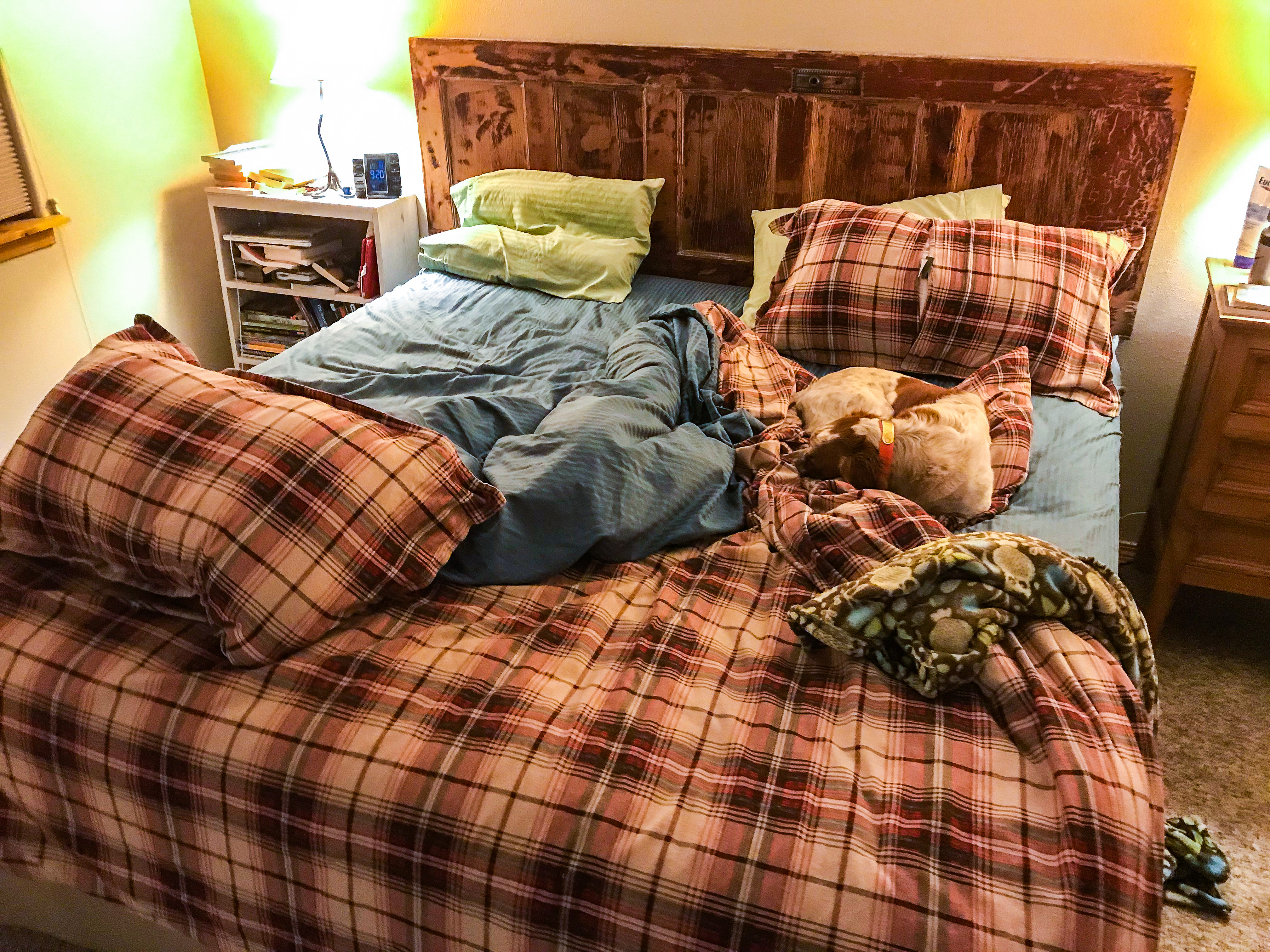
    Both our dogs spend most of the night with us in bed. They occupy different places, moving around, changing positions from fully stretched out (it’s amazing how long they can make themselves and how much king-size bed real estate they can commandeer) to curled like a furry donut, recalling the small circles of dirt I’ve seen while elk hunting which coyotes have carved out of snow for their beds in the woods. Often, they’ll each head to bed before we do, as if to let us know they’d prefer we join them, even though it’ll be 7:30 or 8; usually, this is a day they hunted or got a lot of exercise.

    Bedtime, on a hunting day…

    Angus prefers my side of the bed, at the end where my feet would be, with his head near the edge, and he’s always there while I’m getting ready for bed. Often I’ll sit next to him on the bed while I floss, and put my nose to his while I’m doing my cat-cow stretches on the floor before getting into bed. He expects me to move him toward the middle of the bed, which I do as carefully as I can — we both have arthritis in our lumbar area — and then I give him a neck, back, shoulder, and hip massage, which he seems to enjoy and I like to think has helped allow him to hunt hard without noticeable reduction in effectiveness well into his 12th year of life. I’ll finish by rubbing the inside of his ears, which always elicits a sigh of satisfaction, and giving him a kiss on his forehead.

    Peat the retired sheet wrestler

    Peat’s bedtime routine also begins before we get into bed, but is far more dramatic than Angus’s. Peat is the first “sheet wrestler” we’ve ever had. For the first couple years of his life, whenever he jumped on the bed — whether it was bedtime or not, and this could be several times a day — he’d violently pull the covers and pillows of the fully-made bed nearly clean off so only the fitted sheet remained intact. He still does this, but not quite as frequently. He also sheet-wrestles the couch, although we don’t keep sheets on it; instead, he removes the seat-back cushions and pillows, violently and haphazardly ejecting them from the sofa, clearing a space for himself about the size of the interior of a VW bug. We believe he’s trying to make a nest for himself, but his approach is like Genghis Khan on crack. Once finished, and it’s anyone’s guess what precisely might create the signal of completion in his brain, he collapses into a ball with a huge sigh, gives us a look that says, “Why must you make me do this every night?” and goes to sleep.

    A Modest Proposal: Peat must barricade himself from all potential interlopers
    A half-baked effort for a fully-baked dog

    One of the good things, and there are a few, of being an insomniac, is that I get to witness my dogs sleeping on our bed more than someone who is a sound sleeper (such as my wife). I love seeing them dream, sometimes with their tails quivering happily as though they’re slaloming through sage on a fresh partridge scent. Angus, much more than Peat, occasionally whimpers while dreaming, sometimes desperately, which worries me and makes me reach over and gently pet him to interrupt what might be a canine nightmare. But who knows? Still, I consider it one of the great gifts of bonding with a dog to be able to imagine what they might dream about. This will always matter to me.

    Peat dreaming of alectoris plethoris

    Leslie also loves sleeping with our dogs, but she doesn’t get to witness the experience as much as I do because she’s, well, asleep. But she knows it happens, and often falls asleep serving as another one of Peat’s particular sleep-foils. He’s got his particular positions with her as he does with me; with Leslie, Peat takes advantage of the fact that she sleeps on her side, which gives him more surface area to collect body heat (at least that’s my guess).

    Peat in his usual place with Leslie, often after I’ve gotten up to go to school.

    I realize not everyone sleeps with, or approves of sleeping with, their bird dogs. The reasons for not doing so might be moderately persuasive to an open-minded person: their restlessness can interrupt your sleep cycle; it makes them soft; you can get meningitis and giardiasis from them (I often wonder about this since both our dogs are both saprophagic and coprophagic); it’ll ruin their ability to tolerate temperature extremes; it will damage their olfactory receptors; and they’ll ruin your sex life. I’m sure there are other reasons, but I really didn’t do much research on the question because I’m not actually interested in changing my behavior because I am pretty close-minded about this. First, my sleep cycle can’t be any more interrupted than it already is, and it has nothing to do with dogs on the bed; I’ve had insomnia as long as I can remember, at least 25 years before ever getting my first dog. Second, if my dogs are “soft” from sharing my bed, I shudder to imagine what a hardened version of themselves would do to the local chukar population; I fear chukar would go extinct from “point-fright.” Next, given the frequency, for more than a decade, of wet, bacteria-laden, often feces-infused canine saliva from Angus’s (and now Peat’s) licks and kisses, and the fact that I’ve never gotten sick from them, I’m not too worried. Maybe I’ve developed an immunity or something, or it could just be luck and I’ll actually end up dying from a kiss, like Jesus did. I can think of worse ends. Fourth, it does seem my lazy dogs are overly sensitive to heat, especially in the early season. But I can honestly say that I’ve never considered their endurance to be a limiting factor on my hunts. If anything, it’s always and only the reverse. And as far as cold goes, I’ve seen them shiver a few times, but — again — they can endure much more than I can, and it’s not like I’d ever ask them to go hunting by themselves when it’s 20-below. Fifth, similar to the “softness” question, if my dogs’ noses functioned better than they already do, I’d feel so sorry for the birds that I’d probably have to stop hunting as it would no longer be “fair chase.” Finally, well, I’d better not talk about the last thing.

    My ancestors, I’m pretty sure, slept with dogs, and some of them probably still are sleeping with them. I’m talking about those medieval knights (I realize I’m assuming I’m descended from at least one knight like this) whose graves are adorned with brass rubbings showing them in their armor, with the two most important things a knight could own: his sword, and his faithful dog. The dogs are always at the feet of the knight, which makes sense aesthetically and otherwise. The best sense it makes to me is that it’s a bridge from then ’til now: the two most important things I own, when it comes to chukar hunting at least, are my gun and my dog.

    A brass rubbing I did in England in 1978, now hanging in my classroom.

    The question always arises: were these loyal dogs buried with the knights? I’ve heard that they were but then that brings up the terrible question, what if the dog was still alive when the knight died? I couldn’t find any answers to this on the Internet, so I’m betting the dogs’ bones aren’t actually in the graves with the knights, but rather that they’re symbolic. Of what I’m not sure, but probably they symbolize what dogs would symbolize on anyone’s memorial today: loyalty, unconditional love, one could go on. Maybe even the poet Billy Collins’ ideas about what dogs think of their owners might pertain.

    Curious what your dog might think of you? You might be surprised.

    I doubt I’ll be buried with one of my dogs. I think I’ve asked to be cremated, and unless an awful coincidence occurs and my dog and I shuffle off this mortal coil at the same time I’d be horrified if someone even thought of dispatching my dog so he (or she) could go with me. But I wouldn’t mind if what was left behind of my brief stint on earth was some kind of evidence of my love for these creatures (which might seem over-the-top to those lucky bastards who’ve had dogs their whole lives; I didn’t get my first dog until I was 38), and — if I am lucky — their love for me.

    I love sleeping with bird dogs. These bird dogs.
  • What’s In Your Vest Vol. 2

    What’s In Your Vest Vol. 2

    A few years ago I posted something about what’s in my vest, partly to seek advice and partly to offer it. I got lots of great ideas from the comments on what to include and what to jettison. I haven’t learned much since (both good and bad, I guess), but thought I’d do a quick update; if nothing else, it gave me a chance to remember what I’ve stashed away in my vest. There were some surprises, but nothing dramatic.

    The innards

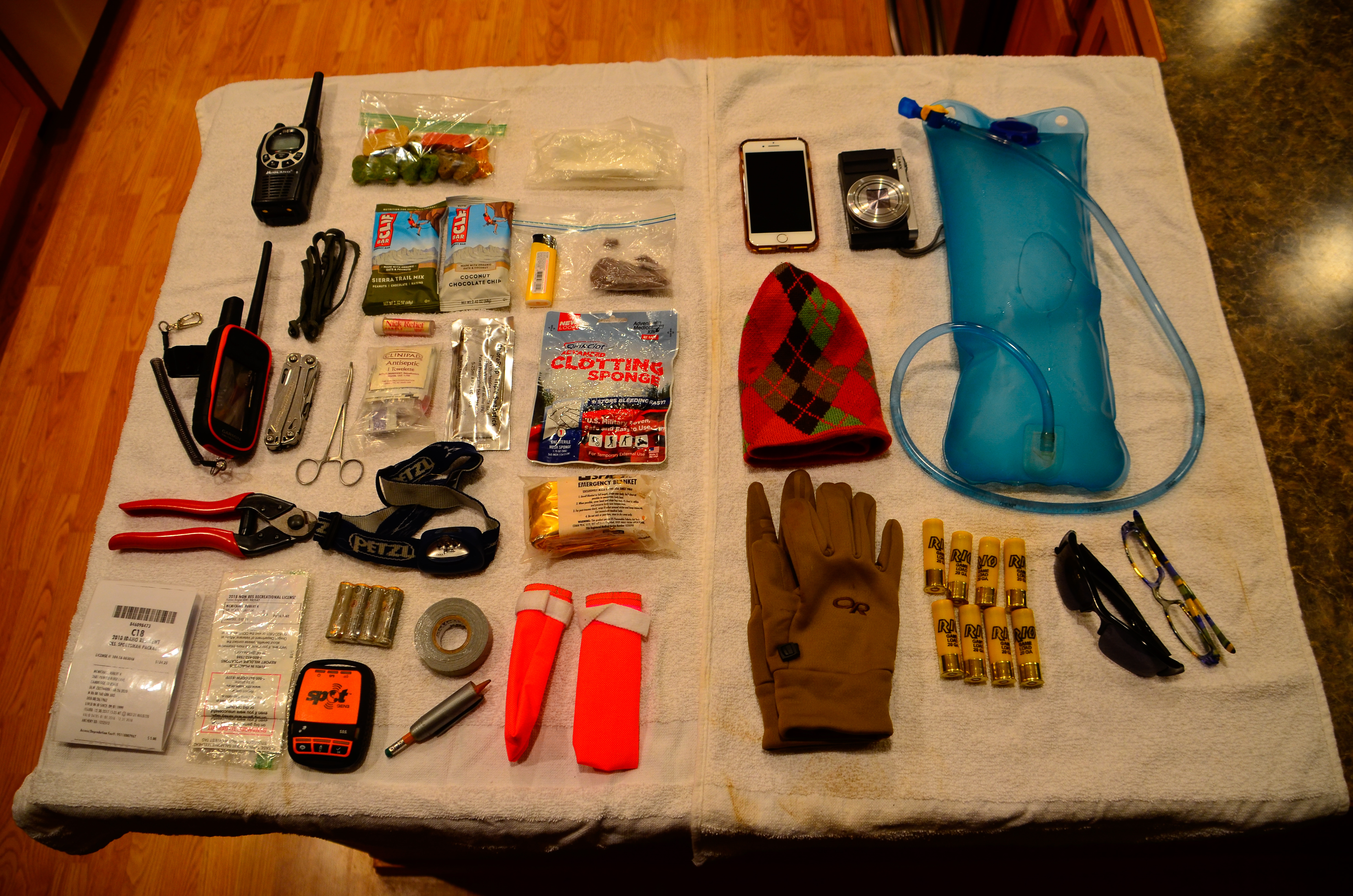
    I’m still using the Badlands Upland Vest, and this is what I carry in it on most hunts. It all fits without much trouble, and there’s actually some more room in some of the pockets. It’s just that there’s not much room for bulkier things like extra layers, or a shell, and not really a good way of attaching an extra jacket or a rain shell onto the pack without a modification of some kind, or a goofy strap attached somewhere… Anyway, from upper left:

    • Midland GXT1000 radio. Important note on this radio: I was about to look for a different radio because I got sick of these running out of batteries in the middle of every hunt, even when I didn’t have them turned on the whole time. It turns out they come with a battery pack that’s super low amp-hour rated (something like 1200 mAh), and I found a suggestion on a forum of dumping the battery pack and replacing it with rechargeable Li-Ion batteries, which I found on Amazon for cheap; they’re 2800 mAh, and I haven’t had to recharge them all season! And this radio works great at long distances, even without line-of-sight.
    • Dog treats.
    • Toilet paper in ziplock.
    • Cell phone: sometimes I bring this instead of a camera, but the zoom sucks, so I use it mainly for ONXMaps I’ve downloaded for the area I’m in to show property boundaries, especially when I haven’t hunted there before.
    • Panasonic Lumix DMC-ZS50: I got this mainly because its zoom is amazing, and pretty clear fully extended (the elk photos from a recent hunt were taken with the fully-extended zoom).
    • 100 oz. Camelback bladder: I’m an unconvertable bladder guy, and this time of year rarely fill it since the dogs eat lots of snow and I’m just not that thirsty when it’s 20 degrees, windy, and I’m slogging through 6 inches of white stuff. In the early season, though, I routinely run out, and often determine the end of the hunt based on my water supply.
    • Garmin Alpha: this is my third season with the Alpha and TT15/TT15-Mini, and I’m sold (after criticizing people who used them; I’m open to eating crow, and developing a taste for it). I will say that the first TT15-Mini I bought for Peat lasted only two years, which is unconscionably short for the $300 collar. I tried replacing the battery, did a bunch of trouble-shooting and research, asked Garmin if they’d repair it (no response!), and ended up just buying another. The original TT15, honking big, is still working fine with no issues (knock on wood), but it’d really be too bulky on little Peat’s neck.
    • 8 feet of paracord with a loop tied in it for collapsing conibear trap springs.
    • Leatherman Wingman: heavy, and heavy-duty. I could ditch this for a lighter pocketknife, but I’ve used a bunch of different things on it already and just feel safer knowing it’s there.
    • Stainless curved locking forceps: haven’t had to use these yet, and hope I don’t.
    • A couple of Clif Bars: sometimes I forget to re-stock these and for two reasons it’s never a problem. First, Leslie usually carries extra food and I’m a decent moocher. Second, as my friend Dale said in response to my earlier post about this: it’s a hunt, not a picnic, and you’re not going to starve on a 5-hour hike.
    • Butane lighter: I used to carry a magnesium fire stone with built-in flint, but last night I tried using it (never had before) and could not for the life of me start a fire with the thing, even in the comfort of my home and after watching the instructional video. Oh well. I was never a Boy Scout.
    • Ziplock with dryer lint, which is supposed to be a good fire starter. I didn’t try igniting this; maybe I should.
    • Ziplock with some bandages, wipes, and antibiotic ointment.
    • InfaLab Nick Relief Styptic Powder: a recommendation for stopping small bleeds.
    • ChloraPrep Triple Swabstick: someone recommended this, and it’s expensive so I’m not sure where I got it, but it’s light, doesn’t take much space, and might come in handy.
    • Quikclot Advanced Clotting Sponge: someone recommended this, also expensive, but it seemed like a good idea to have just in case. With Murphy’s Law determining so much of the cosmic order of things, I feel better knowing it’s there.
    • Felco C7 Cable Cutters: heavy, expensive, and worth your dog’s life if it gets caught in a snare you can’t undo. (Cutting a snare is at 6:45 in the video.)
    • Headlamp: I’d forgotten this was in my vest, but am glad it’s there.
    • Space Blanket: I just like saying “space blanket” and think having one in a chukar vest is appropriate beyond description.
    • Extra hat and gloves: depending on the season, these might or might not be in my pack, and possibly I’ll trade them out for warmer or cooler items, depending…
    • Shells: we’re now a two-Benelli family, and Leslie has commandeered my 12-gauge Ultra Light (but I’m about to reneg on that deal and return her 20-gauge Montefeltro) which impacts the weight and number of shells one might have in the vest. Right now there are 20 1-ounce/7.5 shot 20-gauge shells in my vest, but I can only fit 15 12-gauge shells in the same pocket. I’ve only needed more than 15 shells once this season (and ran out that day in the middle of lots of birds!), and have averaged just 4 shots per hunt for my 33 outings this season (but 6 of those hunts were skunks).
    • Extra glasses: I need cheaters for fine print, which I’d need to read to use any of the first-aid stuff. I don’t carry extra sunglasses, but they’re on my hat about half the time on each hunt, so I counted these as “carry” items.
    • Idaho Sportsman’s Combo license: this is a photo-copied and laminated copy of my hunting license on one side, and my driver license on the other. I’m honestly not sure if that’s legal, but don’t like carrying my heavy wallet in my vest and don’t like moving my driver license from one place to another because I’ll eventually lose it or have to tell the ISP that my DL is in my bird vest. Does anybody else do this?
    • Oregon non-resident license: I should have my head examined for buying this, but I had the best of intentions.
    • SPOT Gen3 emergency beacon: a very cool device that can be a life-saver, and your pal at home can track you on a computer (if you like that idea). Beware of the annual subscription cost (mine was $225 this year), and that you’ll need a Search-And-Rescue membership on top of that. I have an auto-renew SAR membership for Leslie and me that costs $35 a year through GEOS.
    • Spare batteries: these are AA, and I’d forgotten they were in my vest, but I guess I thought I’d use them for my radio if the batteries died. The headlamp uses AAA, so not much use there…
    • Duct tape: I have a 1/2″ roll I got for taping dog booties more securely onto Peat’s wee feet, but had forgotten about the several feet of regular width tape wrapped around a short pencil.
    • Finally, dog booties from Dogbooties.com, out of Anchorage, Alaska. These things are amazing, and cheap. They stay on, don’t slip on ice like the rubber ones do, are super durable, and come in all kinds of cool colors. Plus, they’re super easy to install and remove. Peat spent about 4 entire hunts in these things (just on his front paws), and got used to them very quickly, and was not impaired or hampered from them.

    So that’s that. The only modification I’m thinking of making right now is to figure out how I can bring the honking Nikon D7000 with 18-300 lens along with my gun and vest so I can hunt and take good photos. So far I haven’t been able to figure out how to do that, and with my back issue it’s probably a good thing I haven’t tried. Greedy? Next year I’m thinking of giving the Wingworks vest a try… the Badlands is hard to beat, but the price for its streamlined-ness is that it’s tough to get birds in the pouch when the pockets have a bunch of stuff in them. So I’m thinking of next year already.

    I’d love to hear from people about their ideas for vest essentials, or if you think I’m missing something crucial or should get rid of something…


  • Haunting

    Haunting

    Yesterday, we carefully sneaked out of the house to head down to the canyon with just Peat, leaving Angus behind. The old warrior Angus has been running lots of miles hunting the past couple of weeks and against his will we forced him to take the day off. We knew getting ready to go wouldn’t be easy without him catching on so we put both Peat and Angus inside the car in the garage while we dressed and loaded up our hunting gear into pickup outside. Once ready, we let them back into the house and corralled Peat outside into the pickup and drove off and looked back as Angus was watching in disappointment from the fenced yard.

    The higher mountain elevations were blanketed with a fresh layer of snow overnight so we decided to hunt in a spot down in Hells Canyon, a place we hadn’t walked around this season and where there wasn’t as much snow. Our starting point was an easy spot to access right off the highway. Bob decided not to hunt so Peat could have a chance to hunt for me for a change. In the past so far, and we’re not sure why, but whenever Bob hunts, Peat prefers to only stay with him. As with all hunts down in the canyon, the terrain dictates that the only way is up so we headed up a small game trail in a thick draw lined with brush and trees hoping to find some grouse on the way up. Within five minutes, Peat busted through the brush and stopped above us, barking his head off. His bark was different this time, not his usual high pitched barking he makes when he flushes a grouse up into a tree. His bark was deeper and had the sound of fear in it. We quickly made our way up to him and found the source of his agitation. A big beautiful bobcat with haunting golden eyes was caught in a trapper’s snare underneath some bushes. I was angry. How could a trapper get away with putting a trap in an area close to a popular bird hunting area where hunting dogs could also get accidentally caught? Trapping bobcat in Idaho is totally legal from Dec 14-Feb 16 in this area so there was nothing we could do but walk away. We normally carry heavy duty wire cutters in case the dogs ever got into a snare but they were at home in Bob’s hunting pack. I would never mess with any trappers traps unless one of the dogs got caught in one and I would never tamper with or free wildlife from traps because it’s actually illegal to do so.

    Trapped cat

    Trying to put the whole affair behind us and forget about it, we continued our climb up about 1,500 feet with Oregon at our back and up into the snow that we were trying to get away from in the first place before finally getting into some birds.

    Fence line ascent
    The wall

    Once at the top of the steep climb, Peat found and pointed a covey of Huns and I managed to knock down one as they busted and flew downhill over the ridge. Peat, not used to hunting with just me, was confused on whether to bring the bird to me or to Bob.

    First point of the day
    The retrieve
    Thank you Peat!
    Pointing chukar
    Pointing a covey of chukar
    What next?
    Heading down and away from the draw

    The bluebird sky, amazing views, and Peat brilliantly hunting just for me made up for our terrible start. Yesterday’s hunt will be forever remembered as “Bobcat Gulch.” Now knowing that traps are in the area we will probably never hunt there again and especially not during trapping season.

  • A Gift

    A Gift

    Our annual Christmas Day hunt this year was spectacular. Last year pissing rain forced us to abandon our Hells Canyon hunt and sully ourselves with a silly quail jaunt: it was a 5-minute hunt because I brought 3 shells, which I spent in the first two minutes and hit nothing. Peat was so disappointed that, after I was ammo-less, he pointed and then — as if to demonstrate the sheer ridiculousness of the affair — nabbed a solo unsuspecting quail. Not this year.

    Starting to feel a lot like Christmas
    Cervus canadensis
    Healthy herd

    A thin blanket of day-old fresh snow. Bluebird sky punctuated by running veils of wispy clouds politely skirting the sun. 50 head of strangely calm elk. We went high and found some grouse hawthorned along a tightening draw where we’d busted a bunch of chukar the week before. No partridges in those trees. We climbed higher but it was not until we’d erased half the elevation that the dogs pointed, and it wasn’t until we’d gotten back to within a mile of the truck that we got into numbers. Until then, mostly one or two chukar in random places, in the wind, in the frigid shade, in the creek bottoms. But, even closer to the truck, a big covey busted wild, and we followed, which ended up doubling our outing.

    Climbing

    I shot deplorably. 2-for-12. Leslie fared better at 1-for-3. But it’s hunting, and was tremendously fun to see so many birds and try to catch up to them in thick cover. The birds we bagged were hard-earned and highly appreciated. Peat stuck with me as usual, and gifted me with some gorgeous points and two stellar retrieves. Angus the aged warrior managed, with some coaching from Leslie, to track down her lightly winged chukar that had run across the trail and into the creek; I watched her nifty shot while high above on a hill. Another gift.

    Whenever you go out you have no idea what awaits, and it’s only afterward that you’re aware of that, yet — at least for me — it’s probably the most magnetic thing about chukar hunting. Any hunting, really, if it is hunting. That’s really the gift, life in compressed form in a setting you choose with the creatures who mean most. Every hunt is like Christmas. On Christmas, it’s even better.

    Meaningful creatures
    Angus’s gift
    Evidence
    Predator grateful for prey

  • Sequence

    Sequence

    Leslie traded her gun for the Nikon yesterday and caught a remarkable sequence on a chukar bust. She actually busted two birds behind me, and Angus went after the lead bird. The bird in the photos is the second bird. When I look at Angus in the third photo, it’s hard to reconcile the fact that he’s almost 12 years old with what I’m looking at. It makes me happy. Click on the photos to make them big.

    It was a gorgeous day to be out. Here are some other shots Leslie nabbed. I got nothing. Except joy from seeing so many birds and tracks and happy dogs. And from being able to hike sort of like normal.

    A very healthy pheasant population on private land