Author: Bob McMichael

  • Liminal

    Liminal

    “The short man followed, limping, terrific, crablike.”

    Nearly through reading 900 pages of Faulkner short stories, and can’t get rid of the sentence above. For some reason. Yesterday, while doing research for a story I’m writing, I came across a Cree word that any bird hunter would appreciate: “Papêtikwâskopaniow.”

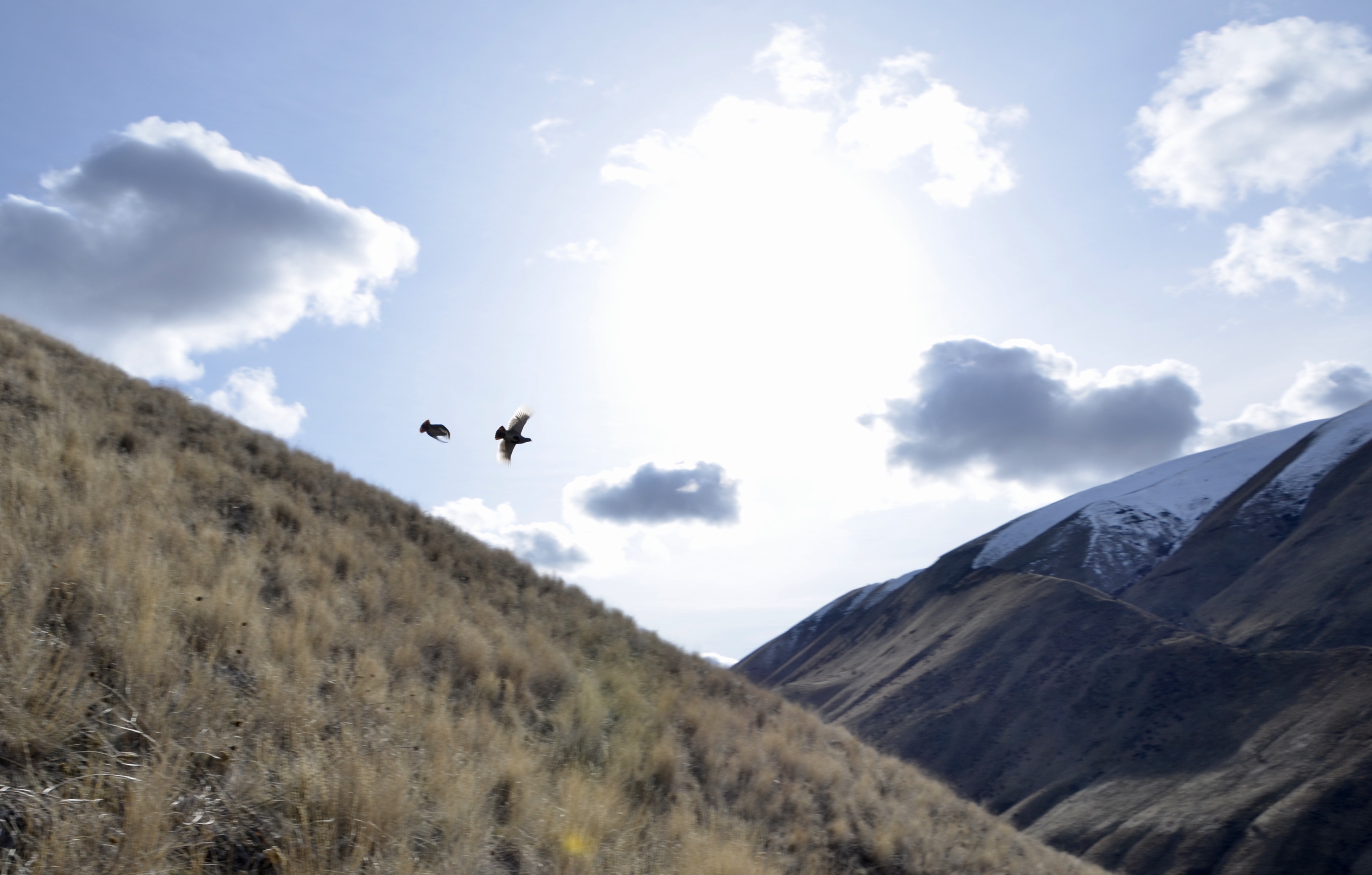
    I wish I could pretend I knew how to pronounce it. But it means the thundering sound a partridge makes with its wings when it takes off.

    We’re always, all of us, until we die, in between things. Words and sentences stick with us, for some reason or reasons (often inexplicable), that mark a point in time and place that’s there as a kind of anchor. I’m sure I’m driving Leslie crazy by randomly repeating (usually as she’s about to fall asleep at night) that sentence from Faulkner’s story “Death Drag.” I can’t explain why I like it so much, but I know I do and am fine with leaving it at that. Then there’s the Cree word, which I might say a lot about. Each of these linguistic landmarks will bookend a moment in my life later on that will remind me I was in the middle of something intense here, in this case not really the kind of intensity I would choose, but just one of those life things that we’re always in the middle of. My stepmom likes to say, after an emotional response to something, that she was “in the middle of being moved.” It’s like that. But it seems, probably for everyone, that we’re always in the middle of something, whether it’s being moved or not. For me, this marked moment has to do with moving. And it’s moving, too. But see, that’s another story.

    The Cree word, for obvious reasons, struck me. When I came across it I was simply looking for the Swampy Cree (“N Dialect”) word for “hello” on an online Cree dictionary. Hello? Maybe you can think of the thunderous surprise of a grouse busting right at your feet as a kind of greeting. More likely, the word came up because of a coding glitch. But I’ll take the connection; it makes some sense. The bird flipping you the bird? There are all kinds of ways to say, and all kinds of ways to interpret, “hello.” Lookout, idiot! Nice to see you again. Is anyone there? The word itself is liminal, and the context and how we see it gives it its meaning. One of my favorite lines from Hamlet nails it: “There is nothing either good or bad, but thinking makes it so.”

    Papêtikwâskopaniow. Good: it’s beautiful to me, enviable even, that the Cree have a single word that captures such an incredible, shocking, powerful, complex experience, especially if you’re a bird hunter. Bad: English doesn’t. But then, these judgments are of course culturally contingent and biased. Liminal. Can we say it matters who we are and where we come from? Who gets to say that? And who gets to say how we feel about killing a bird?

    We do. We must. So what do you say?

    One thing I love about the Cree word is the agency it gives to the partridge. Some of us talk about “fair chase,” so this matters. For Cree, and most First Nation people, “prey” are so much more than that. This word makes it clear it’s the bird who makes the sound with its wings, and it’s a specific kind of sound. One word. You’ve experienced the sound. When you replay that moment reflected by that word I would bet your brain slows it down so you can see it, so you can get in the middle of it. Liminal. The bird is leaving one place and going to another, and anyone who’s watched a big dusky grouse do this in dense woods or even in grassland knows that even that bird doesn’t know for a while exactly where it’s going. And when it’s a covey of chukar, or waves of a super-covey, what then? The sensations. And where does this leave you? Do you shoot? Can you?

  • Starts to Be

    Starts to Be

    Do you believe in miracles? –Al Michaels, 1980

    And I, whose childhood
    Is a forgotten boredom
    Feel like a child
    Who comes on a scene
    Of adult reconciling,
    And can understand nothing
    But the unusual laughter,
    And starts to be happy
    –Philip Larkin, from “Coming”

    The animals are endlessly regenerated, and yet they are finite. I am more powerful than the animal because I kill and eat it. The animal is more powerful than I because it can elude me and cause me to starve. The animal is my benefactor and friend. The animal is my victim and adversary. The animal is different from me, and yet it is like me, as much like me as its ancestors were in the earliest time of the world.
    –from Grateful Prey: Rock Cree Human-Animal Relationships, by Robert Brightman

    Hunting can be confusing. Not hunting for two seasons, really, gives you even more time to get even more confused. Yesterday, that confusion shifted planes, and I’ve been trying to make sense of it. Leslie and I have talked a lot about it, and we came to the same conclusion: it was a miracle, and Angus had a lot to do with it.

    We’ve been camped at one of our favorite spots in Hells Canyon for three days. It’s where we scattered Angus’s ashes on our last day as Idahoans. It’s warm, it’s too early for the birds to be here; they’re down near water. But we wanted to “hunt” here anyway, just because. The dirt is talcum. There’s nothing green anywhere, and the two creeks in the area are scant trickles with numerous undulating ridges between them. The first day we hunted nearby, and the only sounds to accompany the hike were our boots crunching old arrowleaf balsam root and other dried-to-hell ground cover. The second day we went to another favorite spot from our past, partly out of curiosity to see what it looked like after a massive fire that had torched the area two years ago. While the burn was hard to see, the landscape had changed entirely: instead of the sagebrush and bitterbrush hillsides and flats — perfect habitat for chukar and Huns — the entire drainage was now a vast sea of dense dried western wheatgrass 4- to 5-feet tall and next to impossible to walk through. Scarce of partridge. Still, we were out with the dogs.

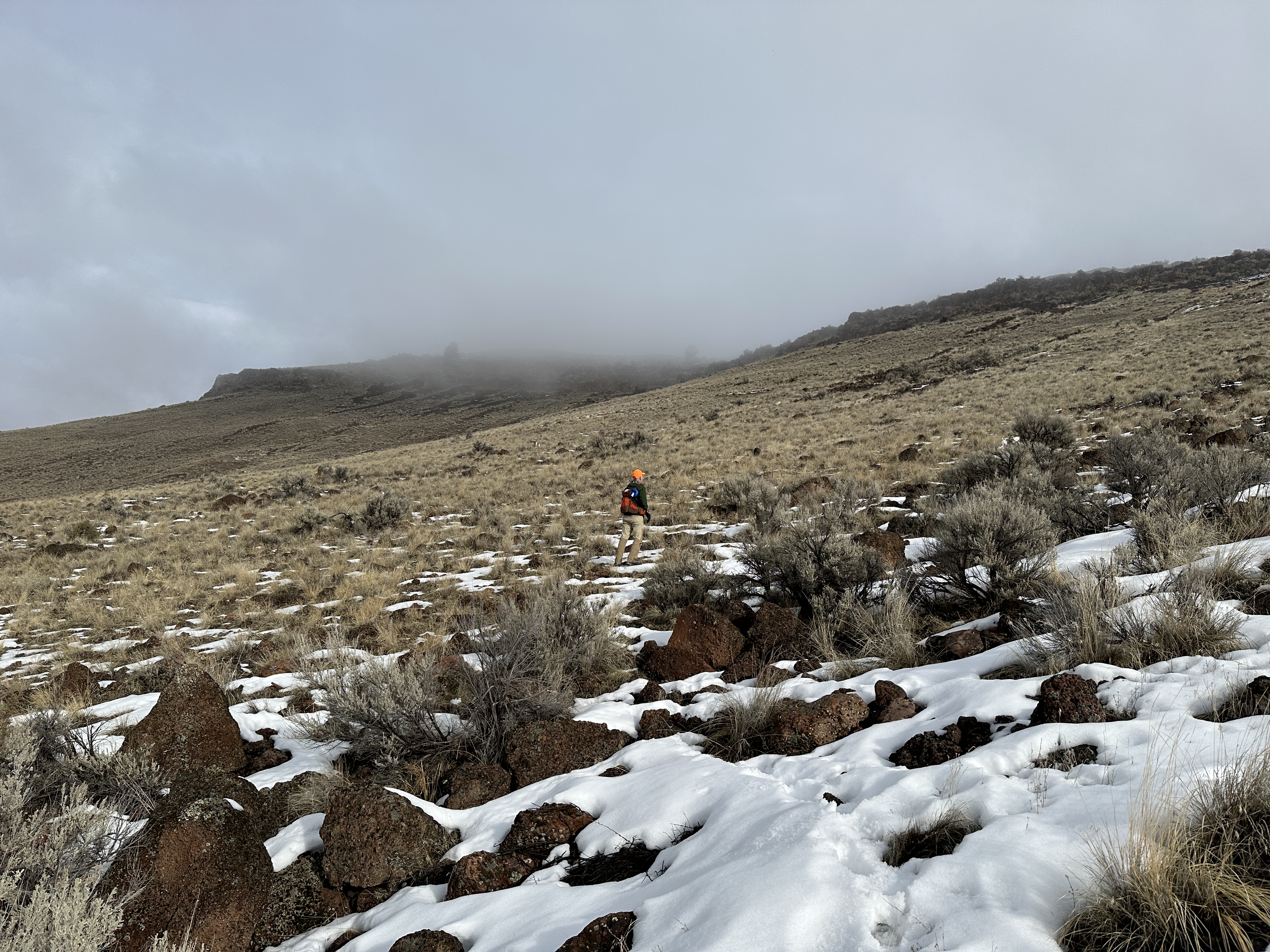
    The third day, yesterday, we went early because of the heat. Another favorite spot, a ridge we call “The Ridge.” We had low expectations but wanted to do more reminiscing, I guess. Leslie, who’s not fond of grouse hunting, said, “Well at least we should get into some grouse on the north-facing timbered slopes.” We saw one. The dogs, as usual, worked their butts off, but Peat was feeling the heat and had his range thirst-shortened. At one point, when we both realized we’d forgotten to bring any food and it was really heating up, we nearly turned around. We decided to circle one more knob before heading back. As we came near a flat at the apex of the last circle, our Garmins told us Peat was pointing about 150 yards away. I said, “He’s probably lying down in the sage shade.” But then I added, “Never doubt your dog.” As we inched closer to Peat, still unable to see him, he remained on point, while Bloom was still cruising somewhere. As I got to about 30 yards from Peat, still hidden in the sage, Bloom suddenly stopped and pointed. Just then I saw two creatures on the ground in the open near the sage. They were big, and for a moment my brain didn’t know what to do with them. A second later my brain told me they were the first chukar I’d seen in nearly two years. And in that same moment they flew. I traced one of the two birds with my barrel as it ascended and I fired and watched it drop. Then I heard Leslie yell, “I got one!” Waves of chukar kept launching and I just watched. There must have been at least 60 birds. I understood nothing but the ballet of dogs and birds and started to be happy. For me, this is the best moment of hunting and why I like it. Jouissance.

    None of those birds should have been there. They shouldn’t have been anywhere near. Leslie fired one shell I had hand-loaded two years ago with steel #6 shot buffered with Angus’s ashes. His soul knew we were here, and he put those birds there for us, even though every member of the super-covey probably thought, “What the hell are we doing here?” And, consistent with Angus’s deadpan humor, he knew we’d need at least 50 birds for a chance at two. Dogs are sanguine like that.

  • Blooming

    Blooming

    and those receive me, who quietly treat me, as one familiar and well-beloved in that home: but will not, oh, will not, not now, not ever; but will not ever tell me who I am.
    –James Agee, A Death in the Family

    We’ve had Bloom a little more than a year now. He’s an odd bird. I have to remind myself that it’s all relative. Everyone who’s had more than one dog compares the new dog to one(s) before. It’s a little unfair but we can’t help it. Of the four Brittanys, he’s the uniquest dog we’ve had so far. Even my first, Glenna, fit some prior description I had of “dog,” plus I had data from my brother’s Brittanys, and she didn’t deviate enough to warrant pause. Angus almost immediately improved on a known thing, by a good stretch. Peat initially (and easily) fit the antichrist character. Good to have got that learned. But Bloom, Bloom. Bloom. Whom?

    We named him after a fictional character we like, Leopold Bloom, from James Joyce’s Ulysses. Joyce’s Bloom is a decent chap, one of the decentest. We thought, hoped, the new puppy would live up to his name. So far, I’d say he’s a good man, boy, dog. But it’s taken the entire time we’ve had him to gain even a preliminary idea of who he really is. He doesn’t show a lot of self-awareness. And there’s something in his eyes that is more like nothing than I’ve seen before. He seems, just lately, to be trying out patterns. We’ve worked with him as consistently as we can, but might as well have named him Enigma.

    Still, we love him well. Maybe once we spend time with him on the chukar hills we’ll be able to tell him who he is, but I kind of hope not. I’m finding I’m admiring the mystery a little bit, just as I admire how he moves. He does have the “Angus lope,” but with even more power.

    We’ll have more on him soon. For now, here’s a look at him growing. A scene near the end of the video shows Peat and Bloom playing in the yard during snowfall last Christmas Day. Leslie took the video while I played the pipes downstairs.

  • Yay

    Yay

    Soon we’ll head east to the west we’ve missed. Chukar season is on in Idaho, and we’ll have tried-and-true Peat and apparent prodigy Bloom with us in our travels to new (for us) and familiar places. We are excited. I’m so excited I made a silly little video of Peat. I’ll probably post one of Bloom soon, too.

    Enjoy.

  • The End and the Beginning

    The End and the Beginning

    NOTE: I began this post in April, part way through my last quarter as a teacher at Neah Bay High School. I didn’t finish it for some reason. Now I want to get it out.

    In the grass that has overgrown
    causes and effects,
    someone must be stretched out
    blade of grass in his mouth
    gazing at the clouds

    — Wisława Szymborska

    It’s been a tough year for me out here away from birdland. I’ve missed so much and have done a terrible job dealing with that frustration. I’ve turned self-pity from a Georges Seurat triptych to El Capitan. Nothing gets through, and you know it won’t, so you stop trying.

    Or you should.

    But I haven’t, even though I’ve told myself a thousand times I should. Leonard Cohen puts it this way:

    Ring the bells that still can ring
    Forget your perfect offering
    There is a crack, a crack in everything
    That’s how the light gets in

    Until this afternoon I’ve all but ignored that light (despite focusing, obsessing on the cracks). Right now I’m sitting at my desk in my classroom overcome with overdetermined light and a few tears shed by an epiphany coming from a conversation with a student about the last stanza of Wisława Szymborska’s 1993 poem, “The End and the Beginning.” “…someone must be stretched out / blade of grass in his mouth / gazing at the clouds.” The poem is about recovering from the destruction of war. I hadn’t read the final image correctly, and I hadn’t even chosen the poem but rather used it as one of the readings in a canned textbook unit (something I’d never done until now, which — if you’re a teacher — will tell you something about my state of mind). And so here comes the student, trying to finish writing answers to the questions in the textbook, and we worked through it together, and we both saw the light at the same time. Dead center in the stanza is the word “must,” which is a word we must become desensitized to in order to endure parents’ and teachers’ and authority figures’ orders, or to make haphazard guesses as to whom is knocking on the door (“It must be the postman…”). But everything depends on that word here because, without it, the thing that signifies recovery can not happen. Someone must be lying there on the grass without a care in the world.

    When I was about 10 years old, still disgusted by the two-year-old fact that the Beatles had broken up, I edged up the alphabet to the next good thing to listen to: Beethoven. My favorite composition of his is the adagio to his string quartet Opus 132, the “Heiliger Dankgesang,” which he wrote after recovering from a near-death experience. If you haven’t heard it, it’s worth a listen because I think anyone can hear the joy of a kind of breakthrough, and we can all use that kind of experience from time to time. It was a rough year, two years, for everyone, and we’re still not out of it. Remember that, and remember to remember that you yourself are not exempt from the need for TLC. There were many times this past year when I felt I’d reached the end, and things like this string quartet, or like the experience with the student (I wish I felt I had the space here to do justice to that moment, and to the student himself) cracks open the chance for a beginning. We all must have those moments. They’re everywhere, but sometimes hard to see.

    So I’ve missed birdland, as I knew I would but didn’t know how much it would matter, and now see the chance to return to it, wherever or whenever that may be. All the responses to my previous post (“Granted“) were so kind and thoughtful and sincere and helpful. They’re the light that’s got through the crack, and I’m so grateful for it. I’m also just now realizing that after Beethoven, the next musical light that came on for me was just up the alphabet a bit: Bird (Charlie Parker). Which makes me think of Steven Feld’s amazing book on the Kaluli Indians of Papua New Guinea (Sound and Sentiment), whose existence is wholly wrapped up in the sounds of birds in the rain forest they live in (they rarely actually see the birds because the forest is so dense), so much so that when they describe those sounds they weep. Tears of joy. At the end of his time living with the Kaluli, Feld played them a recording of Charlie Parker, telling them he was called Bird. When they heard the recording, they wept. Tears of joy. I can hear the chukar calling.