This has been an angst-filled season (and it’s not quite over) but it’s also had some unprecedented good things.
Here’s what I’ve learned this year that contributed to the angst:
- Leslie, in her 3rd season, gained confidence and skill, as well as an independent hunting style, as any good hunter should; this proved difficult for me since I’m stubborn and pig-headed and want to hunt my way, which differs from hers. So we often disagreed over where and how and who would get which dogs to hunt with.
- UTVs are becoming more of a nuisance and negatively impacting habitat, bird numbers, and others’ experiences. I’d heard of folks with big-running pointers driving UTVs along the roads in the Andrus while their dogs scoured the land, and that they’d stop when the dogs went on point and walk over to them. I doubted many did this, and thought about my neighbor Sam, an octogenarian (who only uses his UTV to get to spots to hike; he doesn’t road hunt with it) — I can understand older folks not able to scale the steeps still wanting to taste the chukar medicine, so I kind of forgot about this issue. Until I saw it first-hand: a bunch of able-bodied dudes in their 30s and 40s with multiple UTVs bedecked with custom aluminum dog boxes driving along the road, waiting for their pointers to beep on birds, and then they’d park the UTVs (sometimes right in the road), release the little setters to help bolster the pointer, and mosey over for the murder. I’d say, “To each his own,” but — if you’re able to hike — this is an absolute bullshit way to hunt chukar, and definitely not “fair chase.” This is what the nouveau-riche do on game farms in Georgia and Texas. In case any of this is unclear, I’m not calling out all UTV use in chukar hunting (although there’s a difference between hauling out a limit of chukar and hauling an elk, both of which can be done without a machine). I do worry, though, that public land and wildlife agencies are coming under increasing pressure from lobbyists and manufacturers (and the politicians in their pockets) to expand UTV use as hunters become more swayed by the idea they must have one to do any kind of hunting. Just because you can (and have enough cash), doesn’t mean you should.
- Long-standing bird populations in certain “popular” areas have relocated, most likely due to increased pressure. Idaho Fish and Game, and other agencies across the nation, report that hunting license sales are declining. Chukar hunters, however, in Hells Canyon and other growing population areas (such as Boise, Bend, Twin Falls, and Ontario) have noticeably increased (Idaho license sales have actually increased 14% since 2011). We’ve noticed this, as has every other hunter I’ve talked to who’s hunted chukar in Idaho and Oregon for more than 5 years. The biologists at the Andrus WMA will concur. The angsty part of this fact is selfish (I’d like bird numbers to improve), but also relates to the previous point about UTVs: when motorized vehicles and big-running dogs cover (often on consecutive days) 40 miles or more per day in prime chukar country (which is 4 to 10 times what a hiking hunter would cover), birds are gonna move and their numbers diminish resulting from what I’d consider unethical harvest and stress (road hunting is not “fair chase”).
- Covey sizes, birds per mile, and individual bird sizes are down (this is only based on my personal experience and informal surveys of other chukar hunters’ experiences this season, as well as my log over the past several seasons). The season in Idaho starts too early and the harvest limit should return to 6. I’m as guilty as anyone for hunting when Idaho’s season starts because I can’t help myself (and I do feel guilty about that). Neither can lots of people. We want to get out there. But the early start means lots of downy feathers and shrimpy-sized chukar, as well as smaller and more scattered coveys later in the year. Give the new birds a fairer chance at reaching adulthood, when they might fly well enough to beat the odds and live long enough to breed. And I’m sorry, but nobody needs 8 birds a day; based on the tailgate shots I’ve seen this season (often with a UTV in the frame), it seems lots of folks have no problem shooting a limit. I’ve always been able to find birds, but even if I shoot my absolute best, I’d have to hike 16 miles to harvest 8 birds; I’ve averaged about 5 miles per hunt this season, which is a record for me, so unless I double my shooting percentage and miles per hunt I’m pretty safe from limiting (I’ve averaged 2 birds per hunt this season, another best, which includes grouse and Hungarian partridge).
- Medusahead Rye is getting much worse, exponentially taking over some areas it didn’t exist in three or four years ago. Biologists in Oregon and Idaho are concerned because it quickly eliminates other vegetation and cannot be controlled or mitigated in chukar habitat, and chukar do not stay in mono-typic ecosystems.
- Chukar will be all but extinct in Hells Canyon and other places in Idaho and eastern Oregon within 20 years if things continue the way they are. Medusahead by itself might accomplish this impressive feat. But with increased pressure, the expansion of UTV use, the early season start, and excessive harvest limits chukar hunting does not seem sustainable. I’m not a scientist, but I know Fish and Game biologists are aware of and concerned about these threats yet they don’t have the budget to conduct studies that affirm these concerns, and the agency and its myopic legislative overlords want to make hunters happy in the short term (i.e., sell as many licenses as possible!).
- Social media has creepily colored chukar hunting (along with the rest of existence). I’m talking mainly about Twitter (which I never use but only know about because it has become, surreally, our country’s governance platform), Facebook, and Instagram; I don’t consider blogs per se as social media because it takes more time and effort to write and read a blog post than it does to post something on Instagram or Facebook or Twitter — has helped publicly enable and amplify our most vitriolic and inhumane traits; this is obvious to everyone who uses these things. If you’ve followed this blog this season, you’ve seen that attitude leak into some of the comments and a couple of my posts responding to this disturbing trend. If you follow Instagram, you might have noticed several upland hunting wannabe “influencers” out there whose main goal appears to be to promote themselves to get “sponsorships” and amass “followers” and “likes” (which can be, and are, purchased by the “influencer”). One of these wannabe influencers in particular, who’s distinguished himself by posting photos of himself with dead game birds in compromising (highly sexualized and disrespectful) positions, and who was the focus of a mostly slow-motion video by a well-known upland hunting promotional group (which deletes any comments on the video that aren’t hagiographic, as is their right), recently stated that he wanted to be the “badly-needed figurehead” of upland hunting (since when did upland hunting need a “figure-head”?). No, this is not a precis for a bad novel, although the thought has crossed my mind… Predictably, this post generated a mass of attacks from other wannabe “influencers” on Instagram, one of which appears to exist solely to make fun of hunters who take themselves too seriously but actually seems to be focused more on attacking a specific conservation group and its president. And on and on. These little wars and battles. This discourse. Three years ago I was unaware of any of this and obliviously torturing myself in pursuit of public land partridge. Thus my new year’s resolution to unplug from it all: I have enough angst from other, more honest, sources.
- Small American manufacturers, some of whom make bird hunting vests, don’t appear to be faring too well. The three best known vests for their popularity with chukar hunters have been hard to come by this year, if not impossible. While I have no idea what’s behind this for these particular companies, it’s frustrating and weird (angsty) in the 2020 economy, which is supposed to be so amazing, to see obvious production slowdowns or outright stoppages. Soon I’ll have a review of the vest I waited over a month for.
- Angus getting cancer.
Enough ranting. The good things:
- Angus appearing to beat, or at least hold off, cancer, for now. Diagnosed on August 30th and given 1 to 3 months to live, we allowed ourselves to hope only for one chukar hunt with him. We were ecstatic on opening day to have him with us. He’s hunted the entire season as well as ever (with a few more days off than before, but he is, after all, almost 13).
- We’re hunting harder than ever, if not smarter and better. This is why I keep a log. In all the categories I track (miles, duration, elevation gain, dog miles, shots, kills, and averages of these per hunt), this season is better than any previous season, with the exception of my shooting percentage, which continues to hover just around abysmal. After last year’s spine surgery-abbreviated season, I’m thrilled my body is working well enough to continue this insanity.
- We’ve hunted a bunch of new places (thanks partly to ONX Maps) and have been fairly successful finding birds in each one. It’s good to know that if a place looks like it should have chukar, it probably will (although I will admit that we’ve yet to find any place that has as many birds as we think it should).
- I started reloading our own shells. While I’m pretty sure this is not an economically sound endeavor, it’s been fun and a challenging learning experience. I haven’t found “the perfect load” (open to suggestions: send me your recipes!), but have had some apparent improvements with some loads (although the data set’s pretty small to come to any solid conclusions; biorhythmic theories might hold more water).
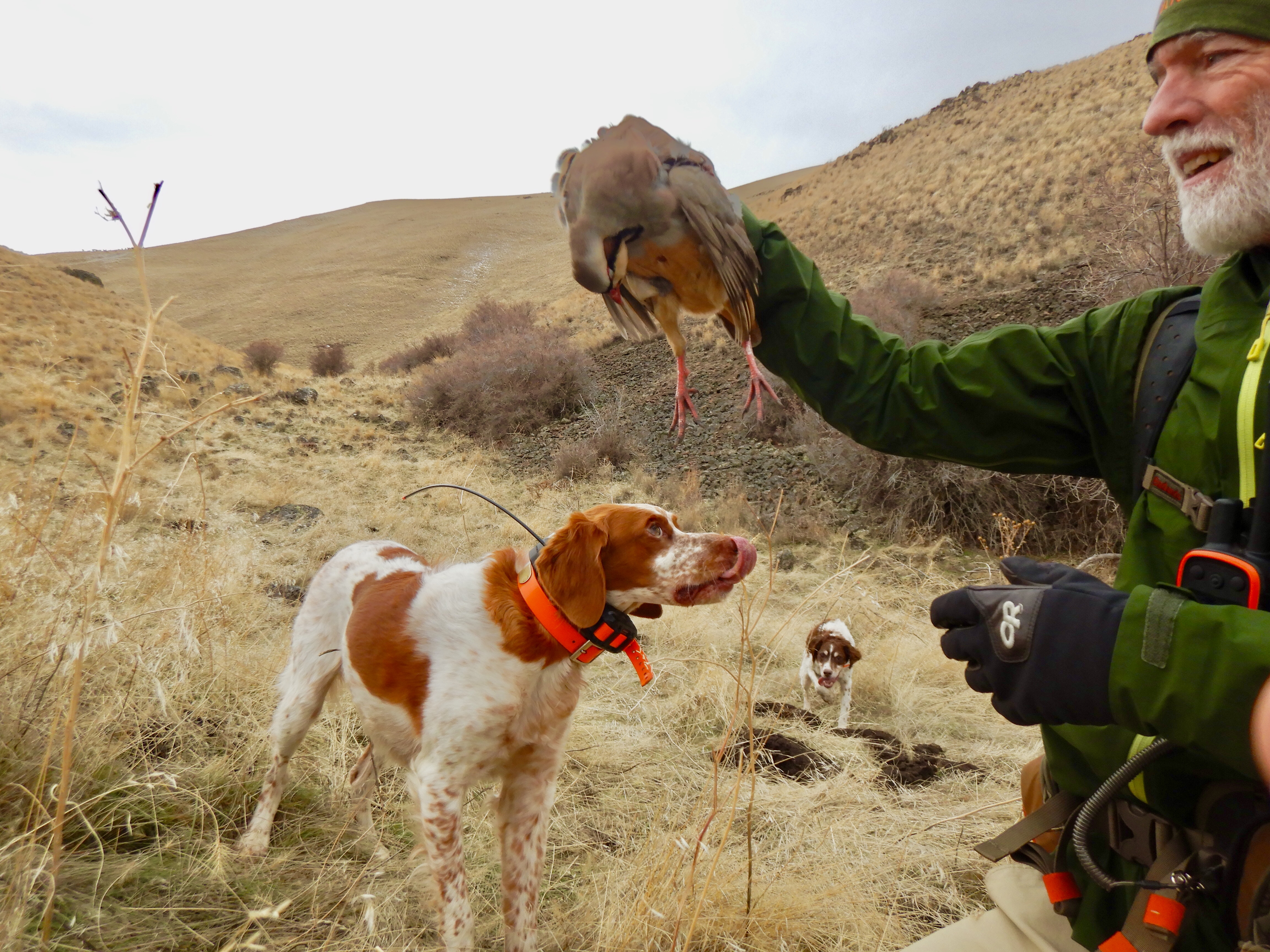
- Peat is better than ever. That’s saying a lot, because he was already really good, and has been since the end of his first season. This season he’s just been great, in both solo and partner situations. He’s become stealthier, and yesterday he showed me more clearly than ever that his number one concern when he finds birds is to hold them or — at the very least — make sure they don’t bust before I’m within range. I’m convinced he knows exactly what my shooting range is and isn’t, which I find remarkable. Yesterday he found a covey of chukar and pointed them from a reasonable distance. The birds slalomed through the sage, but Peat didn’t want to risk busting them so he held still. Angus came along and — as I’ve always known he’ll do — crept past Peat and followed the ambulating chukar carefully. Peat, the consummate backer, wanting to stay connected to the action, executed his short bursts toward the birds, at one point (see photos below) wedging himself discretely between a large rock and sage bush! He’s covering more miles and slightly extending his range and, as a result, finding more birds than ever. He’ll be 5 this spring, and I’m already lamenting (very prematurely, I know) his demise. I should probably take comfort in knowing that he’ll far outlast my ability to hunt these birds (if they don’t go extinct before then).
- Sunburst Brittanys is not only still in business, but doing very well and still producing phenomenal chukar hunting dogs that naturally point, back, and retrieve. Just as wonderfully, their dogs are good family dogs. This sounds like an advertisement, and maybe it is, but it’s heartfelt. Not a day goes by where Leslie and I don’t marvel at our canine-caused joy, whether it’s somewhere on a ridge during the 4-month season, floating down the Missouri in a drift boat, poaching heat and affection from them in bed, or watching them enjoy being the dogs I’d trade my life to be.
So there you have it, the bad, the good, and the no-good-to-look-at. And there’s still a few weeks before that sad, long off-season. I hope I haven’t bummed anyone out too much, but it is what it is. At this point, if there’s even one person still reading this, I’d count it a success. Best wishes to all for a good 2020.